

Understanding Compound Interest: What It Is and How It Works
Imagine two friends who start saving money at the same time, with the same initial amount. One lets the accumulated earnings sit in an account that doesn’t reinvest the gains. The other invests everything in a product where the interest from each period is added to the principal and earns interest along with it. After a few years, the difference between the two balances can be surprising — and significant. This difference has a name: compound interest.
Understanding how compound interest works is one of the most important foundations of financial education. It is present in both your investments and your debts. When it works in your favor, it can be a powerful ally for wealth growth over time. When it works against you — in a credit card with overdue installments, for example — it can turn a small debt into a much larger problem than expected.
In this article, we will clearly explain the concept, show how the calculation works in practice, present real examples, and help you understand how this mechanism appears in your daily financial life.
What Exactly Is Interest?
Before getting to compound interest, it’s useful to understand the broader concept of interest: the cost of money over time. When you lend money to someone — or to a financial institution, as happens when you invest — you forgo using it now. In return, you receive compensation for this. That compensation is interest.
Similarly, when you borrow money from a bank or use your credit card limit, you pay interest for accessing a resource that isn’t yours.
There are two basic types of interest:
- Simple interest: interest is always calculated on the original amount (the so-called principal or initial capital). It does not accumulate on itself.
- Compound interest: interest from each period is added to the principal, and in the next period, interest is calculated on this new total. It’s called “interest on interest”.
The Formula for Compound Interest
The mathematical logic behind compound interest is simple to understand when visualized step by step. The classic formula is:
M = C × (1 + i)^n
Where:
- M = final amount (the total value at the end of the period)
- C = initial capital (the amount you invested or borrowed)
- i = interest rate per period (expressed as a decimal; for example, 1% = 0.01)
- n = number of periods (months, years, etc.)
Illustrative Example
Suppose you invest $1,000 in an account that yields 1% per month, with automatic reinvestment of earnings, for 12 months.
- Month 1: $1,000 × 1.01 = $1,010.00
- Month 2: $1,010 × 1.01 = $1,020.10
- …and so on.
At the end of 12 months: $1,000 × (1.01)¹² ≈ $1,126.83
If it were simple interest (1% per month on the original capital), the total would be: $1,000 + ($10 × 12) = $1,120.00
The difference of $6.83 seems small in one year. But over longer periods and with larger amounts, this difference grows significantly.
Time Is the Key Ingredient
The most powerful factor in compound interest is not the rate — it’s time. The longer the period, the more pronounced the effect of reinvesting earnings.
To illustrate this without promising specific returns (as real rates vary and depend on the product, economic conditions, and risk), consider the general principle: the sooner you start investing, the more compounding periods your money has available. Each additional period not only adds — it multiplies the effect of the previous ones.
This is why financial educators often emphasize that starting early matters more than starting with a lot. A modest amount invested over decades can surpass a larger amount invested for less time, depending on the conditions.
The Rule of 72 — A Useful Mental Shortcut
There is an estimation calculation called the Rule of 72: divide 72 by the annual interest rate to get an approximate idea of how many years it would take to double a capital under those conditions.
Example: with a hypothetical rate of 9% per year, 72 ÷ 9 = 8 years to double the capital (approximately).
Note: this is a simplified estimate, not a promise of return. The actual rate will depend on the chosen product, market timing, and the risk involved.
Compound Interest in Your Daily Life: Where They Appear
In Investments
Compound interest appears positively in various financial products available in Brazil, such as:
- Tesouro Direto: federal government bonds traded through the National Treasury platform. The yield varies according to the bond (pre-fixed, indexed to the IPCA, or Selic). Updated information is available on the official Tesouro Direto website.
- CDBs, LCIs, and LCAs: issued by banks, they usually yield a percentage of the CDI, which closely follows the Selic rate. The CDI is published daily by B3. To find the current Selic rate, check the Central Bank of Brazil website.
- Investment funds: each fund has its own reinvestment policy and risk profile.
- Savings: yields according to rules linked to the Selic; the exact criteria are described on the Central Bank website.
In almost all these cases, earnings are automatically reinvested, activating the compound interest mechanism.
If you want to understand how products beyond savings can work for your money, read our article How to Make Your Money Yield More Than Savings.
In Debts
The same mechanism that can be your ally in investments can be an enemy in debts. The most critical situations in Brazil include:
- Credit card revolving credit: historically one of the highest interest rates in the consumer credit market. Check the Central Bank for current data on average rates charged by institutions.
- Overdraft: another line of credit with high and compound interest.
- Unsecured personal loans: tend to have higher rates than lines with collateral.
A $500 debt on a credit card revolving credit, if not paid off, can grow rapidly in a few months due to the compounding of interest. This is the side to be urgently avoided.
Taxes and Fees: What Reduces Your Real Yield
When calculating the effect of compound interest on investments, it is essential to consider:
- Income Tax on earnings: many fixed-income investments are taxed by the IR according to a regressive table — that is, the longer you leave the money invested, the lower the rate. Rates and rules are defined by the Federal Revenue and can be consulted on the official website. Products like LCI and LCA have IR exemption for individuals, according to current rules.
- IOF: applies to very short-term redemptions in some investments.
- Administration and custody fees: funds and some platforms charge fees that reduce net yield.
The yield that actually stays in your pocket is the net yield, after all these costs are deducted. When comparing products, always ask for or calculate the net return.
How to Use Compound Interest to Your Advantage: Practical Principles
There is no magic formula or risk-free investment. But there are principles that financial education consistently teaches:
- Start as soon as possible. Time is the greatest amplifier of compound interest.
- Maintain consistency. Regular contributions, even if small, enhance the compounding effect.
- Avoid unnecessary early withdrawals. Each time you withdraw money, you interrupt the compounding cycle.
- Control high-interest debts. Eliminating a debt with high compound interest is equivalent to obtaining the same return without risk — and with certainty.
- Know what you’re contracting. Read the terms, check the fees, and understand the risk of each product before investing.
- Diversify. Every investment has risk. Concentrating everything in a single product increases exposure to losses.
Conclusion
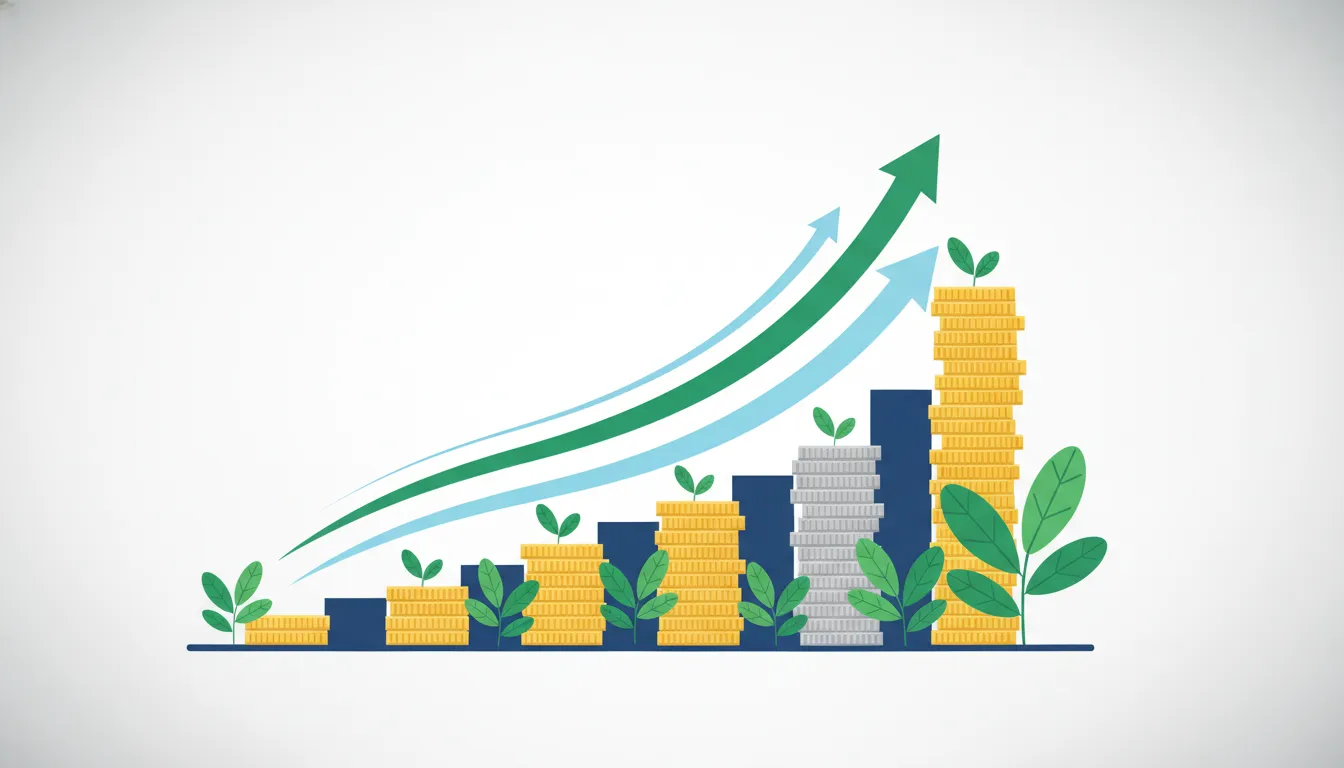
Compound interest is one of the most fundamental concepts in personal finance — and also one of the most underestimated. They are not a secret of those who got rich, nor a promise of rapid wealth multiplication. They are, in fact, a mathematical characteristic of money over time that can work for or against you, depending on how you position yourself.
Understanding this mechanism helps you make more informed decisions: choosing investment products with clarity on how earnings accumulate, avoiding debts with high compound interest, and planning for the long term with more realism.
For information on how money can be used for larger goals, such as buying a property, see our article FGTS to Buy Property: How to Use the Benefit.
The most important step is always the same: seek knowledge, ask questions, and make decisions based on reliable information.
This content is for educational purposes only and does not constitute investment advice, financial consultancy, or any form of personalized advice. All investments involve risk, including the possibility of losing the invested capital. For financial decisions suitable for your profile and situation, consult a certified professional or investment advisor duly registered with the Securities and Exchange Commission (CVM).
