

Investment Diversification: What It Is and Why It Matters
Imagine putting all your savings into a single type of investment. For a while, everything goes well. But then the scenario changes: an economic crisis, an unexpected interest rate hike, an entire sector collapses. Suddenly, much of what you’ve accumulated over years can evaporate in a matter of months. This is the risk of concentrating everything in one place — and it’s precisely to protect against this that diversification exists.
Investment diversification is one of the most fundamental concepts in personal finance and also one of the most misunderstood. Many people hear the term, vaguely know that “it’s good to diversify,” but don’t understand why this principle works or how to apply it in practice. This article aims to change that: we will explain the concept clearly, show how it works, present its real advantages — and also its limits.
An important warning from the start: every investment carries some level of risk. Diversifying reduces certain risks but does not eliminate them entirely. The goal here is educational: to help you understand the concept so you can make more informed decisions, always with the support of a professional when necessary.
What Is Investment Diversification
Diversifying means distributing your capital among different types of assets, sectors, markets, or financial instruments, so that the poor performance of one does not compromise your entire portfolio.
The logic behind this is simple: different assets react differently to the same economic events. When the basic interest rate rises, for example, fixed-income investments tend to benefit, while stocks of indebted companies may suffer. When the economy grows, stocks tend to appreciate, but long-term fixed-rate bonds may lose value in the secondary market. By mixing these elements, you create a more balanced portfolio.
In the technical language of finance, this effect is called correlation. Assets with low correlation tend not to fall (or rise) together at the same time. When you combine uncorrelated assets, the total risk of the portfolio can be lower than the sum of the individual risks. This is the mathematical core of diversification, formalized by economist Harry Markowitz in the 1950s in what became known as the Modern Portfolio Theory.
Main Asset Classes in Brazil
To diversify, you first need to understand the major categories of investments available to Brazilian investors. Each has distinct characteristics, risks, and operations.
Fixed Income
These are investments where the remuneration rules are defined at the time of application or follow a known index. Examples:
- Tesouro Direto: federal government bonds issued by the National Treasury, with different profiles (fixed-rate, inflation-indexed by IPCA, Selic-indexed). Updated information on rates and terms is always available at tesourodireto.gov.br.
- CDBs (Certificates of Bank Deposit): issued by banks, usually remunerated as a percentage of the CDI. The CDI is a rate that closely follows the Selic; both can be consulted on the Central Bank of Brazil’s website (bcb.gov.br).
- LCIs and LCAs (Real Estate and Agribusiness Credit Letters): exempt from Income Tax for individuals but generally have lower liquidity.
- Debentures: corporate debt securities with higher risk and potential for higher returns.
Fixed income does not mean “risk-free”: there is credit risk (the issuer may not pay), market risk (price variation in the secondary market before maturity), and inflation risk (real returns may be eroded).
Variable Income
In this category, there is no guaranteed return. The value fluctuates according to the market.
- Stocks: represent a share in the capital of companies listed on B3, the Brazilian stock exchange. Investors can profit from stock appreciation and dividends but can also lose part of their capital.
- Investment Funds: pool resources from various investors to invest in different assets, according to a policy defined in the regulations. There are fixed-income funds, multimarket, stock, real estate (FIIs), among others. The CVM (Securities and Exchange Commission) regulates and supervises these funds.
- ETFs (Exchange Traded Funds): funds traded on the stock exchange that replicate indices like Ibovespa or IMA-B, allowing diversification with lower operational costs.
- FIIs (Real Estate Investment Funds): invest in real estate or real estate market securities and distribute earnings periodically to shareholders.
International Investments
With the advancement of investment platforms, Brazilians can now access assets abroad — shares of American companies, global ETFs, sovereign bonds from other countries — both through BDRs (Brazilian Depositary Receipts, traded on B3) and international brokers. This adds currency exposure to the portfolio, which can be a protection or an additional risk, depending on the context.
Why Diversification Matters
The direct answer is: because no asset is perfect in all scenarios, and the future is uncertain by definition.
Consider this: in years when inflation spikes, the Tesouro IPCA+ tends to protect the investor’s purchasing power. In periods of interest rate cuts, stocks and FIIs usually appreciate. In times of global crisis, the dollar often appreciates against the real, benefiting those with dollarized assets. None of these assets work well in all scenarios at the same time.
By diversifying, you are not seeking the “perfect” asset — you are building a portfolio that can sustain itself reasonably well under different economic conditions. This reduces the volatility of the portfolio (the fluctuations in total value) and decreases the chance of severe and irreversible losses.
Another important point: diversification is also a protection against what economists call specific risk — the risk of a bad event affecting only one company, sector, or specific country. If you concentrated your entire portfolio in the shares of a single company and it faces a scandal or goes bankrupt, you lose almost everything. If this company represents only 5% of your portfolio, the impact is manageable.
Advantages and Limits of Diversification
It’s important to be honest: diversification is not a magic solution. See both sides:
| Aspect | Advantage | Limitation |
|---|---|---|
| Risk | Reduces specific risk of individual assets | Does not eliminate systemic risk (global crises affect almost everything) |
| Return | Smooths fluctuations, protects wealth | In times of a specific asset boom, total return may be lower |
| Complexity | Allows exposure to multiple markets | Highly fragmented portfolios are difficult to track and rebalance |
| Costs | ETFs and funds facilitate diversification at low cost | Management and custody fees can erode returns over time |
| Currency Protection | International assets protect against real depreciation | Currency exposure adds another type of risk |
The so-called systemic risk — which affects the entire economy at once, like a global pandemic or an international financial crisis — cannot be eliminated by diversification within the same asset class or country. Therefore, diversifying across different asset classes and geographies tends to be more effective than simply buying stocks of ten different companies in the same sector.
How to Think About Diversifying Your Portfolio
Diversifying does not mean distributing money randomly. Some questions help structure this decision:
- What is your goal? Long-term retirement, buying a property in five years, or an emergency fund require completely different strategies.
- What is your time horizon? The longer the term, the greater the ability to tolerate short-term fluctuations.
- What is your risk tolerance? This is subjective and personal — and there is no right or wrong answer.
- Do you already have an emergency fund? Before diversifying long-term investments, it’s essential to have an emergency fund in high-liquidity assets. See more at Where to keep your emergency fund yielding well.
Based on these answers, you can think of an allocation that makes sense for your reality — not your neighbor’s, nor what’s trending on social media.
Taxation and Costs: Don’t Ignore These Factors
Diversification also needs to consider the fiscal impact and costs of each investment. Taxation varies greatly:
- Fixed income generally follows the regressive IR table, with rates ranging from 22.5% (up to 180 days) to 15% (over 720 days). Exact rates and any updates should be checked on the Federal Revenue website (gov.br/receitafederal).
- LCIs, LCAs, and some CRIs/CRAs are exempt from IR for individuals.
- Stocks and ETFs have specific rules for capital gains, exemption on sales below R$ 20,000 per month (for stocks), and dividend taxation that may vary according to current legislation.
- FIIs have earnings exempt from IR for individuals who meet certain criteria.
Besides tax, consider fund management fees, brokerage, custody, and spread. These costs, small individually, can significantly impact returns over the years — especially when combined with compound interest.
Conclusion: Diversification Is a Process, Not an Event
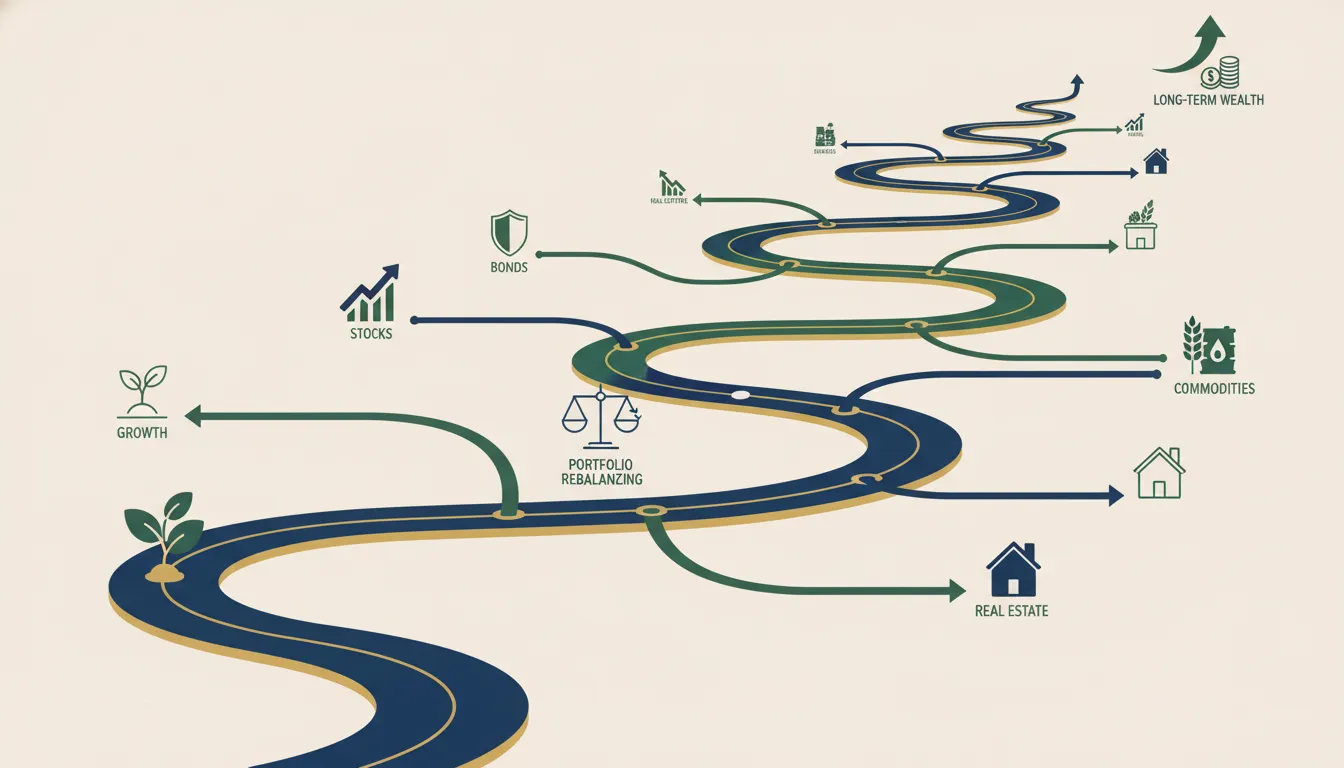
Diversification is not something you do once and forget. It’s a continuous process of review, rebalancing, and learning. As assets appreciate differently over time, the original composition of the portfolio changes — and it may be necessary to adjust it to maintain the desired proportion between classes.
The most important thing is to start with clarity about your goals and limits, build a portfolio that makes sense for your life, and resist the temptations of abrupt changes motivated by headlines or short-term movements. Consistency, patience, and continuous financial education are the true foundations of a healthy investment journey.
> Educational note: This article is for educational and informational purposes only and does not constitute investment advice, financial consulting, or a suggestion to buy or sell any asset. Each person has a unique financial situation. For investment decisions suitable to your profile, goals, and risk tolerance, consult a financial planner or investment advisor duly registered with the Securities and Exchange Commission (CVM).
