
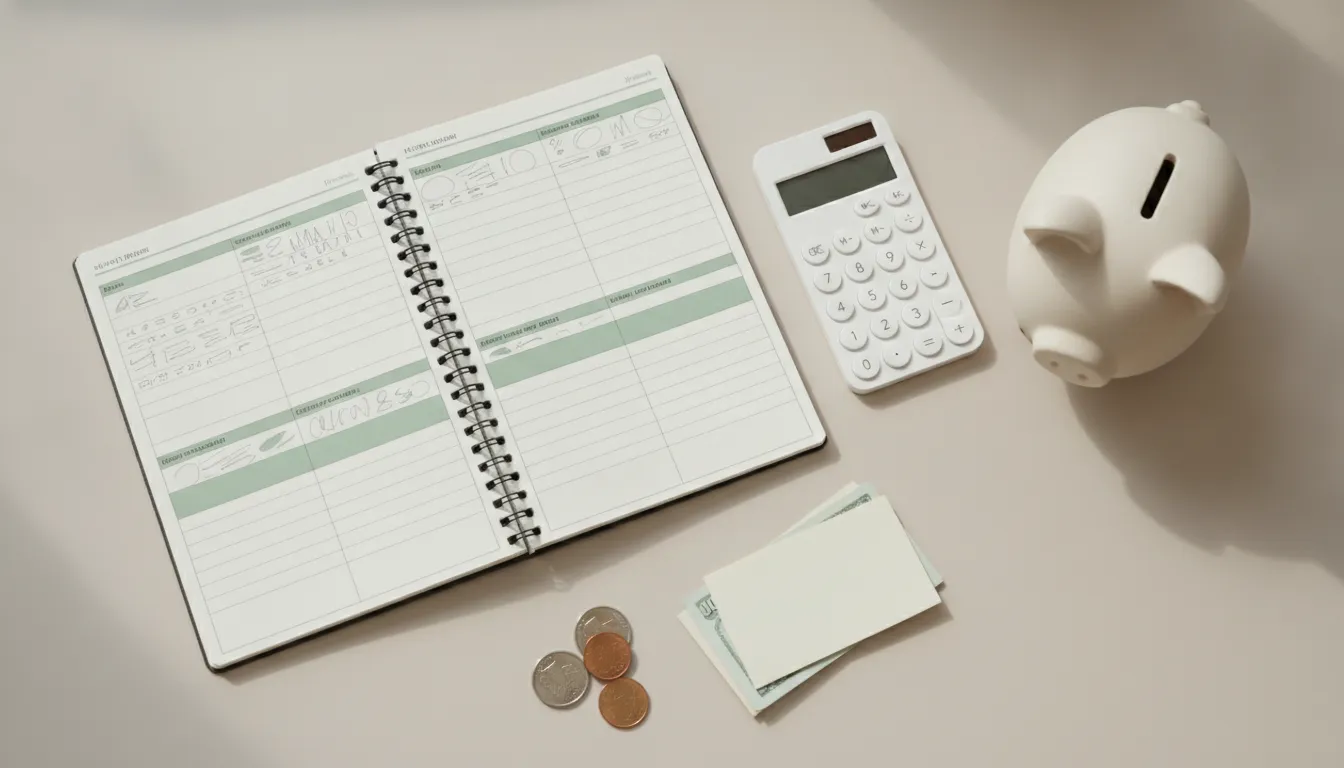
Why Your Money Disappears Before the End of the Month — and How to Fix It
You reach the end of the month without understanding where your money went. The bills are paid, but it feels like nothing is left — not for savings, not for a trip, not for that goal you’ve been postponing for years. If this sounds familiar, you’re not alone. Research by the Central Bank of Brazil consistently shows that a significant portion of Brazilians cannot save regularly, with one of the most cited reasons being the lack of control over personal finances.
The good news is that there is a simple, free, and powerful tool to change this scenario: the personal budget. It’s not a magic spreadsheet or an app that performs miracles — it is, in essence, the act of recording, analyzing, and planning the use of your money with intention. Those who learn to do this well gain something much more valuable than a technique: they gain clarity about their choices.
In this guide, we will walk through the process step by step, from assessing income to creating realistic goals. The idea is that by the end of this read, you’ll have the roadmap to start today.
What Exactly Is a Personal Budget?
A personal budget is simply a plan that outlines how much money comes in, how much goes out, and where it goes. It can be done on paper, in an Excel or Google Sheets spreadsheet, in a notebook, or in financial control apps. The format matters less than the habit.
The goal is not to cut everything that brings pleasure, nor to turn your life into an exercise of deprivation. The goal is to make conscious decisions: knowing that you are spending X on leisure because you chose to, not because the money disappeared without explanation.
A well-crafted budget also serves as a foundation for any other financial step — whether starting to invest, getting out of debt, or planning a high-value asset like a property (you can learn more about acquisition alternatives like the property consortium and how it works in practice).
Step-by-Step to Build Your Budget
1. List All Your Income Sources
The starting point is knowing exactly how much money comes into your life. List:
- Net salary (after deductions like social security, income tax, and other mandatory deductions)
- Income from freelance or self-employed work
- Rental income
- Alimony received
- Any other regular or occasional income
Use net values — what actually goes into your account. If your income is variable (self-employed professional, commissioned salesperson), work with the average of the last six months as a reference, but plan based on the most conservative amount.
Attention: if you have income from different sources, keep records organized. This also facilitates the annual income tax return to the Federal Revenue — an obligation that many underestimate and whose non-compliance has serious consequences (see what happens if you do not declare income tax).
2. Map All Your Expenses
This is the most revealing step — and often the most uncomfortable. For at least 30 days, record absolutely everything you spend: breakfast, transportation, streaming subscription, supermarket, pharmacy.
Categorize expenses into two major groups:
Fixed expenses: amounts that repeat every month with little or no variation.
- Rent or mortgage payment
- Health insurance
- Internet and phone
- School tuition
- Loan or financing installments
Variable expenses: amounts that change from month to month.
- Dining out
- Leisure and entertainment
- Clothing and footwear
- Fuel or app-based transportation
- Miscellaneous purchases
There are also seasonal expenses, which do not appear every month but are predictable: property tax, vehicle tax, school supplies, year-end gifts. Divide the annual amount by 12 and set aside this amount monthly — so they don’t “surprise” your budget.
3. Compare Income and Expenses
Now the moment of truth: subtract the total expenses from the total income.
- Positive result: you have a margin. The next step is to decide what to do with it — emergency fund, investments, debt repayment.
- Negative result: you are spending more than you earn. This needs to be corrected before any other financial decision.
- Zero result: common and dangerous — any unforeseen event turns into debt.
Whatever the result, it is not a moral judgment. It’s just information. And information is what allows change.
4. Apply a Budgeting Methodology
There are several methodologies to organize where each dollar goes. None is universally “the best” — the one that works is the one you can maintain. Get to know the most popular ones:
| Methodology | Proposed Division | Who It Works Well For |
|---|---|---|
| 50-30-20 | 50% needs, 30% wants, 20% savings/debt | Beginners |
| Envelope Method | Physical money separated by category | Those who overspend on credit |
| Zero-Based Budget | Every dollar has a defined purpose (income – expenses = 0) | Those who want total control |
| Pay Yourself First | Save first, spend what’s left | Those who struggle to save |
The 50-30-20 methodology is a good starting point for its simplicity. But note: it is a reference, not a universal rule. Those living in large urban centers may need to allocate more than 50% to basic needs. Adapt to your reality.
5. Set Clear Financial Goals
A budget without a goal is hard to sustain. Goals give meaning to the effort. They can be:
- Short-term (up to 1 year): build an emergency fund, pay off a debt, take a trip.
- Medium-term (1 to 5 years): make a down payment on a property, buy a new car, pay for a postgraduate course.
- Long-term (over 5 years): retirement, financial independence, wealth for children.
Be specific: instead of “I want to save more,” say “I want to save $500 a month for 12 months to have a $6,000 emergency fund.” Measurable goals are much easier to track.
6. Review and Adjust Monthly
A budget is a living document, not an unchangeable law. Set aside a moment every month — it can be the first weekend — to compare the planned with the actual. Ask yourself:
- What worked?
- Where did I exceed the budget?
- What changed in my life that impacts the plan?
There is no perfect budget in the first month. Discipline is built with practice, and monthly adjustment is an essential part of the process.
Common Mistakes When Creating a Budget
Knowing the most common mistakes helps to avoid them:
- Forgetting seasonal expenses: property and vehicle taxes arrive and throw everything off balance. Allocate monthly.
- Underestimating variable expenses: small purchases add up. Record everything, including the coffee.
- Setting unrealistic goals: drastically cutting leisure and pleasure tends to result in abandoning the budget within weeks.
- Not including the spouse or partner: couple finances need to be planned together.
- Confusing revenue with profit (for freelancers and entrepreneurs): the money that enters the company’s account is not your salary. Pay yourself a defined salary.
The Role of an Emergency Fund in the Budget
Before thinking about investments, the budget should include building an emergency fund: an amount saved in high-liquidity investments (that you can quickly withdraw) to cover three to six months of your monthly expenses in case of unforeseen events — unemployment, health problems, urgent repairs.
This money should not be viewed as an investment seeking profitability. The main criteria are safety and liquidity, not return. To know where to safely keep this amount, evaluate options with protection from the Credit Guarantee Fund (FGC) or public securities available in the Treasury Direct. Always check the current conditions directly from official sources, as rates and returns change regularly.
Tools to Put the Budget into Practice
You don’t need anything sophisticated to start. Here are some options:
- Notebook and pen: simple, distraction-free, works for those who prefer physical.
- Spreadsheet (Google Sheets or Excel): flexible and free; there are ready-made templates available online.
- Financial control apps: there are several options in the Brazilian market that allow you to connect bank accounts and categorize expenses automatically. Research reviews and check privacy policies before connecting your banking data.
- Functionalities of the banks themselves: many digital banks already offer automatic expense categorization in their apps.
Conclusion: Start, Don’t Perfect

Creating a personal budget is not a task you do once and forget. It’s a habit developed over time that, when consolidated, completely transforms your relationship with money. Don’t wait for the perfect moment, the ideal spreadsheet, or the right app. Start now, with what you have.
The first budget will be imperfect. The second, a little better. And in a few months, you’ll look back and realize that you finally understand where every dollar goes — and that you are in control of your financial decisions.
> Educational Note: This article is for educational and informational purposes only. No part of this content constitutes an investment recommendation, personalized financial advice, or suggestion of any specific financial product. For decisions related to your financial and asset planning, consult a qualified professional or investment advisor duly registered with the Securities and Exchange Commission (CVM).
