

How to Create an Educational Allowance for Your Children
Imagine your child arriving at college at 18 without ever having made a financial decision on their own. They’ve never chosen between spending now or saving for later, never felt the frustration of wanting something and not having the money, never experienced the satisfaction of reaching a financial goal. This is the reality of millions of young Brazilians — and the educational allowance exists precisely to change this scenario, from within the home, from an early age.
Financial education doesn’t start in the classroom. It’s built day by day, in the small and concrete choices children make with real money. An allowance, when well-structured, is one of the most powerful tools for this: it creates a safe environment where making mistakes has real consequences, but still reversible ones. It’s much better to learn how to handle money at 10 years old, with small amounts, than at 25, with your first job salary.
In this article, you’ll understand how to structure an allowance that truly teaches — not just a monthly transfer without purpose, but a pedagogical system adapted to your child’s age, with clear rules, defined objectives, and room for growth. Let’s go step by step.
Why the Allowance Goes Beyond “Giving Money”
Many parents confuse an allowance with a kind of domestic salary or, at the other extreme, with a blank check. Neither extreme works well.
The educational allowance has three central functions:
- Controlled autonomy: the child decides how to use the money within limits defined by you.
- Natural consequence: if they spend everything early on, they have nothing left until the next cycle. This is the most powerful lesson.
- Financial vocabulary: terms like budget, savings, goal, and priority stop being abstract when real money is involved.
Research in developmental psychology, such as that conducted by Cambridge’s Faceability Lab and disseminated by the British organization Money and Mental Health, shows that financial habits begin to form around 7 years of age. This doesn’t mean you should give an allowance to a baby — but it reinforces that waiting until adolescence might be too late to build solid foundations.
What’s the Right Age to Start?
There’s no single answer, but there are well-established general guidelines:
- 3 to 5 years: Phase of recognizing coins and bills, understanding that money is exchanged for things. Games, piggy banks, and simulations are sufficient.
- 6 to 9 years: Good phase to start a simple allowance. The child already understands cause and effect and can plan in the short term.
- 10 to 12 years: Time to increase autonomy, include medium-term goals, and introduce the idea of saving with a purpose.
- 13 years and older: You can include concepts of basic investing, interest, and longer-term planning.
The most important criterion is not age itself, but the child’s maturity to understand that money runs out and doesn’t come back “automatically.”
How to Define the Allowance Amount
This is one of the points that generates the most doubt — and also one that depends most on family context. There’s no universally “correct” amount, but there are practical criteria to define:
Consider the purpose of the allowance
Before choosing a number, define what the allowance should cover. Some families opt for an “free spending” allowance (ice cream, stickers, games), while others include items of moderate necessity (extra school supplies, gifts for friends). The more comprehensive the coverage, the larger the amount needs to be.
Take into account the family’s reality
The allowance should not compromise the parents’ budget or create a sense of artificial abundance for the child. An amount that is challenging, but not impossible to manage, is the most pedagogical.
Avoid linking 100% of the allowance to household chores
Financial education experts usually recommend that household chores be treated as a family member’s responsibility — not as paid services. This prevents the child from developing the idea that they only act when there’s payment. If you want to use extra chores as a source of additional income, that’s fine — but clearly separate what’s an obligation from what’s a bonus.
Structuring the Allowance: A Practical Step by Step
- Define the educational objective. What do you want your child to learn with this allowance? Impulse control? Saving for goals? Understanding priorities? The objective guides all the rules.
- Choose the frequency. For younger children, weekly allowances work better — the timeframe is more concrete. For teenagers, the monthly cycle already simulates the reality of the adult world.
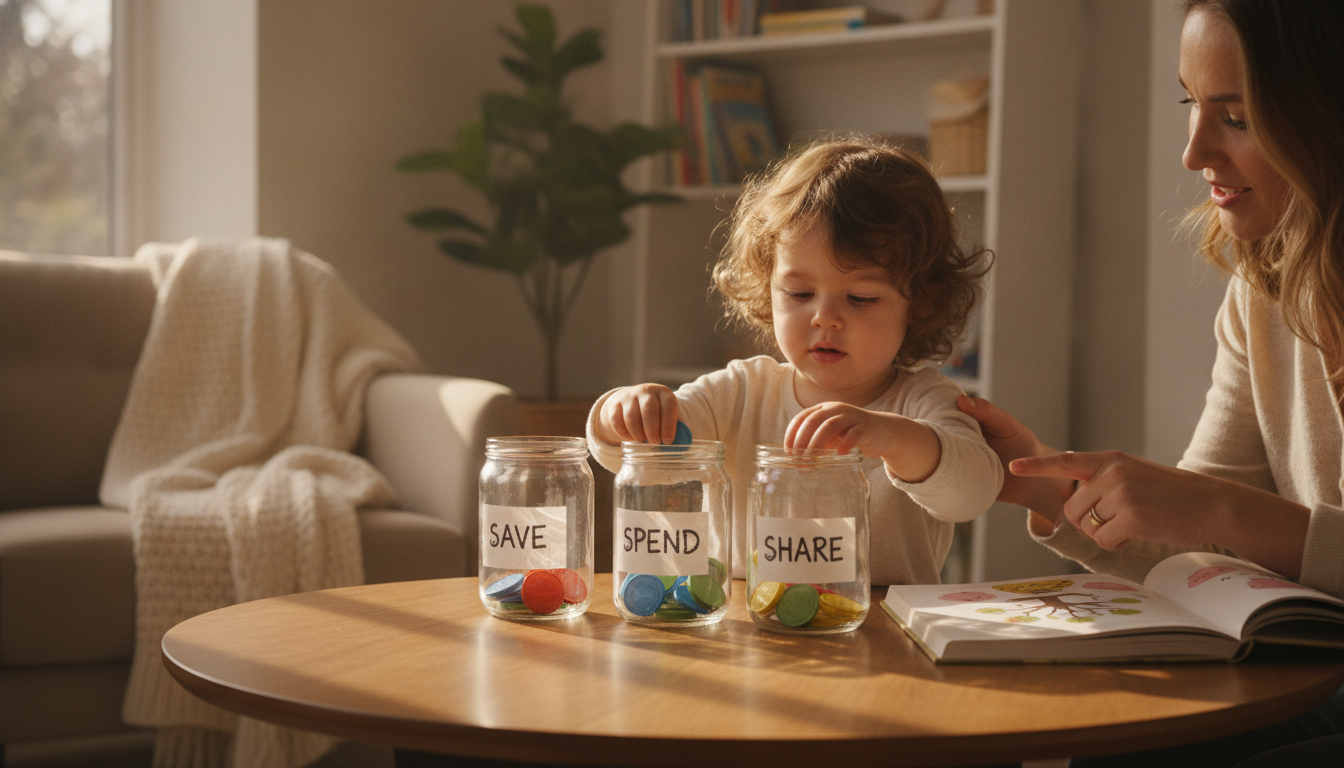
- Establish usage categories. A simple and efficient way is to use three “envelopes” (physical or symbolic):
- Spend: free and immediate use
- Save: saved for a medium-term goal
- Give/share: for gifts, donations, or family contributions
This division into three pillars is a simplified version of the same reasoning behind the 50 30 20 Rule, which you can apply to your own budget while teaching your children.
- Define the non-intervention rules. If your child spent everything in three days and wants more money, what do you do? Define before — and stick to your position. Natural consequence is the greatest teacher.
- Create concrete goals. “Saving money” is vague. “Save $80 to buy game X in two months” is motivating and measurable. Concrete goals make the effort to save understandable.
- Review periodically. Every six months or at every birthday, assess whether the amount and rules still make sense for the child’s development.
- Talk about mistakes without punishing. When your child spends impulsively and regrets it, use the moment to talk — not to rescue them financially or to humiliate them. This dialogue is worth more than any finance book.
Introducing the Concept of Savings and Investment
As the child grows, it’s natural to want to go beyond the piggy bank. And that’s great — but it requires care and precision.
For younger children (up to 12 years): The physical piggy bank is still ideal. Seeing money accumulate concretely is more pedagogical than a number on a screen.
For teenagers: You can introduce concepts such as savings accounts, Direct Treasury, or investment funds — always in an educational way. Explain that savings have variable returns tied to the Selic Rate (defined by the Central Bank, available at bcb.gov.br) and that, depending on the interest rate scenario, it may not beat inflation. Direct Treasury is a federal government program that allows you to invest in public securities with small amounts — but it involves market risks and tax rules that vary depending on the term. Always consult the official Direct Treasury website for updated information on fees and conditions.
What to never do: promise that “the money will yield a lot” or present any product as guaranteed profit. Every investment involves some level of risk, and teaching this early is part of financial education.
Advantages and Points of Attention
| Aspect | Advantage | Point of Attention |
|---|---|---|
| Autonomy | Develops independence and self-confidence | Can generate conflicts if rules are not clear |
| Natural consequence | Teaches responsibility in a lived experience | Parents need to resist the urge to “rescue” |
| Planning | Creates a habit of thinking before spending | Very young children may not have enough maturity |
| Introduction to investments | Brings financial concepts closer to reality | Requires care not to oversimplify or distort risks |
| Family dialogue | Opens space to talk about money at home | Requires consistency and time from parents |
Common Mistakes Parents Make
- Give allowance without clear rules: the money loses its educational potential and becomes just a benefit.
- Cancel the allowance as punishment: this mixes finances with behavioral discipline and confuses the child.
- Complete the money when it runs out: completely nullifies the lesson of consequence.
- Never review the system: an 8-year-old child has different needs and capabilities than a 13-year-old.
- Don’t set an example: it’s pointless to teach planning if parents never openly talk about how they organize their own money.
Conclusion: The Allowance as School of Life
A well-structured educational allowance is, in practice, a miniature financial laboratory. It allows your child to make mistakes with small amounts, learn from experience, and develop, over the years, a healthy and conscious relationship with money.
There is no single model that works for all families. The most important thing is that the system is consistent, transparent, and adapted to reality — both of the child and of the parents. Start simple, adjust as the child grows, and keep the dialogue open. Money doesn’t need to be a taboo at home: the sooner it’s treated naturally, the more prepared your children will be for the financial challenges of adult life.
To dive deeper into the topic, check out our complete guide: Educational allowance: how to teach your child to handle money.
> Educational Note: This article is exclusively educational and informative in character. It does not constitute investment recommendation, financial product, or personalized strategy. Each family situation is unique. For specific financial decisions, consult a certified professional or investment advisor properly registered with the Securities Commission (CVM).
