
# 7 Simple Savings Strategies to Transform Your Finances This Year
Introduction: The Power of Savings in Financial Transformation
Saving money is one of the most fundamental financial skills anyone can develop. However, many individuals face challenges in saving at the end of the month, whether due to lack of planning, discipline, or adequate knowledge of effective saving strategies. The good news is that you don’t need to make extreme sacrifices or earn a fortune to start building a solid financial future.
In this article, you will discover seven simple yet powerful strategies that can revolutionize your relationship with money and transform your finances this year. These proven techniques have helped thousands of people get out of debt, create emergency funds, and achieve their financial goals. As highlighted in our article on financial education, knowledge is the first step to transformation.
Get ready to discover practical and accessible methods that fit any budget and lifestyle. Let’s begin your journey towards financial independence!
1. The Pay Yourself First Rule
One of the most effective and transformative strategies is the principle of “paying yourself first.” This concept, popularized by personal finance experts like Robert Kiyosaki, reverses the traditional logic of saving only what’s left at the end of the month.
Instead of waiting until the end of the month to save what’s left (which is usually nothing), you set aside a percentage of your salary as soon as it hits your account. This amount should be automatically transferred to a savings or investment account before even paying your bills.
How to implement:
Set up an automatic transfer of at least 10% to 20% of your salary to a separate account on the same day you receive it. Treat this transfer as a fixed and non-negotiable bill. Over time, you will get used to living on what’s left and won’t even miss that money.
The advantage of this strategy is that it makes saving an automatic habit, eliminating the need for constant willpower. Behavioral studies suggest that automating financial decisions significantly increases savings success rates.
2. The Envelope Method for Controlling Spending
The envelope method is a traditional technique that has made a strong comeback in the digital age. This simple strategy helps you visualize and control your spending tangibly, avoiding impulse purchases and waste.
The process is straightforward: divide your available money into categories (food, transportation, leisure, etc.) and place the corresponding amount in physical or virtual envelopes. Once the envelope’s money is gone, you cannot spend in that category until the next month.
Modern version:
Nowadays, several banking apps offer the “boxes” or “goals” feature that works like digital envelopes. Banks like Nubank, Inter, and C6 Bank allow you to separate your money into different categories without dealing with physical cash.
This strategy is particularly effective for those who struggle with credit card spending. By physically limiting access to money, you create a psychological barrier that reduces unnecessary spending by up to 30%, according to consumer behavior research.
3. The 52-Week Challenge: Save Progressively
The 52-Week Challenge is a playful and gradual strategy that makes saving less intimidating. The concept is simple: in the first week of the year, you save $1; in the second week, $2; in the third, $3, and so on until the last week of the year, when you will save $52.
By the end of the year, you will have accumulated $1,378 without major sacrifices. The gradual increase allows your budget to progressively adapt to the saving habit.
Variations of the challenge:
– Reverse version: Start with $52 and decrease by $1 per week. Ideal for those who receive their 13th salary at the beginning of the year.
– Multiplied version: Multiply the values by 2, 5, or 10, depending on your saving capacity.
– Monthly version: Adapt the concept for 12 months instead of 52 weeks.
This gamified approach to saving is especially useful for those just starting to develop the habit of saving money. As explained in our article on financial education for children, making finances fun significantly increases engagement and consistency.
4. Reduce Invisible Expenses and Forgotten Subscriptions
One of the biggest villains of personal finances are the so-called “invisible expenses” – small recurring expenses that go unnoticed but can collectively consume hundreds of dollars monthly. Streaming subscriptions, apps, unused gym memberships, and automatic services are the main culprits.
A study by Forbes revealed that most people underestimate by up to 50% how much they actually spend on monthly subscriptions.
Action plan:
1. Review your bank statements from the last three months
2. Identify all recurring charges
3. Cancel unused or duplicate subscriptions
4. Negotiate prices for services you actually use
5. Consider sharing family subscriptions (Netflix, Spotify, etc.)
Many people discover they are paying for gyms they haven’t attended in months, apps forgotten after free trials, or multiple streaming services when they only watch one. Eliminating these leaks can easily free up $200 to $500 per month for your savings.
Set up a quarterly reminder to review your subscriptions and ensure you are only paying for what you actually use and value.
5. The 30-Day Rule for Non-Essential Purchases
Impulse buying is one of the biggest barriers to consistent saving. The 30-day rule is a psychologically powerful strategy to combat this behavior and reduce financial regrets.
The principle is simple: whenever you feel the urge to make a non-essential purchase, write down the item and wait 30 days before actually buying it. If after this period you still desire the item and have the money available, make the purchase without guilt.
Why it works:
The 30-day wait allows the initial emotion to dissipate and lets you rationally evaluate whether you really need that item. Consumer behavior studies show that up to 70% of impulse purchases are abandoned when applying this technique.
During the waiting period, you can:
– Research better prices
– Look for cheaper alternatives
– Evaluate if you already have something similar
– Consider if the item aligns with your financial goals
For lower-value purchases (below $100), you can reduce the waiting period to 7 or 14 days. The important thing is to create a barrier between impulse and action.
6. Automate Your Savings and Investments
Automation is one of the most powerful tools to transform your finances. When you remove the need to make conscious decisions repeatedly, you eliminate decision fatigue and drastically increase your chances of success.
Behavioral research shows that people who automate their savings save on average 3 to 5 times more than those who rely on manual transfers. This is because automation eliminates the temptation to spend before saving.
What to automate:
1. Transfers to savings: Set up automatic monthly transfers to investment accounts
2. Bill payments: Activate automatic debit to avoid fines and interest
3. Investments: Schedule recurring contributions to funds, Treasury Direct, or stocks
4. Emergency fund: Automatically set aside a percentage for this fund
Financial institutions like the Central Bank of Brazil recommend maintaining at least 6 months of expenses in an emergency fund. Automation makes this goal much more achievable.
Additionally, by investing in financial education, you will learn to optimize your automations to maximize returns and minimize risks.
7. Apply the 50-30-20 Rule to Your Budget
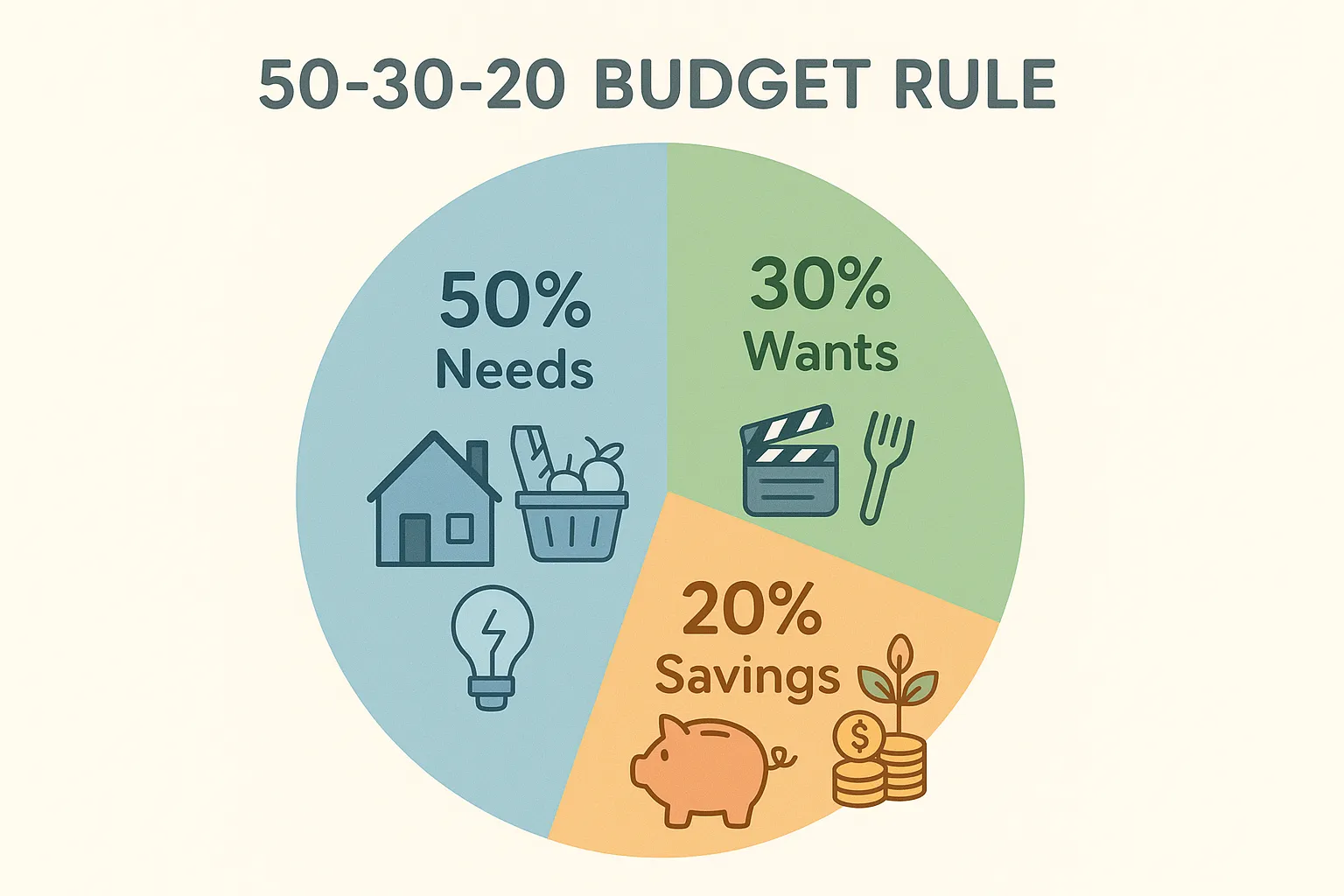
The 50-30-20 rule is one of the most popular and effective budgeting methods, created by American senator and finance expert Elizabeth Warren. This strategy divides your net income into three main categories:
– 50% for needs: Housing, food, transportation, health, essential bills
– 30% for wants: Leisure, entertainment, hobbies, dining out, non-essential shopping
– 20% for savings and investments: Emergency fund, retirement, financial goals
How to implement:
