

# Why Our Children Need to Learn Financial Skills Before Leaving School
Financial literacy is one of the most important skills a person can develop over their lifetime, yet it is also one of the most neglected in the traditional educational system. While our children learn complex equations, historical dates, and abstract physics concepts, many reach adulthood without knowing how to budget, invest, or avoid harmful debts. This gap in formal education has profound and lasting consequences that affect not only individuals’ financial lives but also their mental health, relationships, and overall quality of life.
Preparing our children to handle money before they leave school is not just a matter of convenience—it’s an urgent necessity in an increasingly complex financial world. With easily accessible credit cards, rising student loans, and a constantly changing economy, today’s youth face financial challenges that previous generations could not have imagined. Teaching financial education early on can mean the difference between a life of prosperity and security or a journey filled with stress and economic hardship.
The Financial Reality of Young Brazilian Adults
The numbers reveal a worrying situation. According to recent data, a significant portion of young Brazilians aged 18 to 25 are in debt, many without fully understanding the terms of the contracts they signed or the long-term consequences of their financial decisions. Easy access to credit, combined with a lack of adequate financial education, creates a perfect storm for early indebtedness.
Many young adults incur their first significant debt within the first year after leaving school, whether through credit cards, vehicle financing, or educational loans. The problem is not necessarily the credit itself, but the lack of understanding about how to manage it properly. When we do not learn effective strategies to get out of debt early on, the cycle of indebtedness can perpetuate for decades.
Moreover, the lack of financial education contributes to alarming rates of money-related anxiety among young adults. Research indicates that financial issues are among the main causes of stress in this age group, affecting professional performance, personal relationships, and mental health.
What Happens When We Don’t Teach Financial Education
The consequences of the absence of financial education in young people’s upbringing are broad and often devastating. First, there is the direct economic impact: without basic knowledge of budgeting, saving, and investing, young adults often make impulsive or poorly informed financial decisions that compromise their financial future.
The lack of financial preparedness also creates a ripple effect in other areas of life. Young people who do not know how to manage money often delay important milestones of adulthood, such as moving out of their parents’ house, getting married, or having children, simply because they lack the necessary financial stability. This postponement is not just a matter of personal preference, but often a necessity imposed by poor financial management.
Another critical aspect is the perpetuation of poverty cycles. Families without financial education tend to pass on harmful financial habits to the next generations. Without formal educational intervention, children from economically disadvantaged backgrounds rarely learn about investments, retirement planning, or wealth building, remaining trapped in limiting financial patterns.
According to the Organization for Economic Cooperation and Development (OECD), countries with higher levels of financial education tend to have more prosperous and economically stable populations. Financial education is not just an individual matter but a determining factor for national economic development.
The Concrete Benefits of Early Financial Education
Teaching our children to handle money before they leave school offers immeasurable benefits that go far beyond the purely financial aspect. When children learn about finances early, they develop a mindset of planning and responsibility that extends to other areas of their lives.
One of the main benefits is the development of long-term thinking. Children who learn about investments and compound interest understand the value of delaying immediate gratification in favor of greater future rewards. This cognitive skill is valuable not only for financial decisions but also for academic, professional, and personal choices.
Financial education also promotes autonomy and self-confidence. Young people who understand how money works feel more empowered to make independent decisions and take responsibility for their choices. This contributes to a smoother transition to adulthood and reduces prolonged financial dependence on parents.
Furthermore, financial knowledge is directly related to better life opportunities. Studies show that people with higher financial literacy tend to accumulate more wealth over their lifetime, have higher retirement savings rates, and are less likely to face severe financial difficulties. The financial education promoted by the Central Bank of Brazil recognizes these benefits and has invested in awareness programs.
What Children Need to Learn About Money
Financial education does not need to be complex or intimidating to be effective. There are fundamental concepts that, when taught appropriately for each age group, can completely transform young people’s relationship with money.
For young children, financial education should start with basic concepts such as the difference between needs and wants, the origin of money (work and effort), and simple notions of saving. Using a transparent piggy bank, for example, allows children to visualize their money growing, making the concept of saving more concrete.
As children grow, the concepts can become more sophisticated. Pre-teens can learn about basic budgeting, price comparison, and the concept of cost-benefit. This is also an excellent age to introduce an allowance as an educational tool, allowing them to practice financial decisions in a controlled environment.
Teenagers should receive more comprehensive financial education, including information about credit, interest, basic investments, and long-term financial planning. Understanding how credit cards work, what an interest rate means, and how debt can affect the future are essential knowledge before entering adulthood. Programs like in-person financial education can be particularly effective at this stage.
It is also crucial to teach about different investment vehicles, even if only at an introductory level. Young people should leave school understanding the basics of stocks, investment funds, government bonds, and the power of compound interest over time.
How to Integrate Financial Education into Family Routine
While formal financial education in schools is important, the family plays a fundamental and irreplaceable role in this process. Parents are their children’s first and most influential financial educators, and incorporating conversations about money into the family routine can make a huge difference.
An effective strategy is to include children in age-appropriate financial discussions. This does not mean sharing adult financial concerns with young children, but rather involving them in everyday spending decisions, explaining why certain choices are made. For example, when shopping at the supermarket, explaining why you compare prices or choose one brand over another teaches valuable skills of conscious consumption.
Establishing an allowance or payment system for chores can be an excellent educational tool. The important thing is that the money comes with guidance on how to manage it. Many families adopt the system of dividing the allowance into three categories: spend, save, and donate, simultaneously teaching about financial management and social responsibility.
Creating family financial goals is also educational. Whether saving for a trip, a special item, or a family project, the process of setting a goal, creating a plan, and tracking progress teaches valuable lessons about planning and financial discipline.
It is also important for parents to model healthy financial behavior. Children learn more from what they see than from what they hear. Demonstrating habits like comparing prices, avoiding impulse purchases, and discussing important financial decisions conveys powerful messages about how to handle money.
The Role of Schools in Financial Education
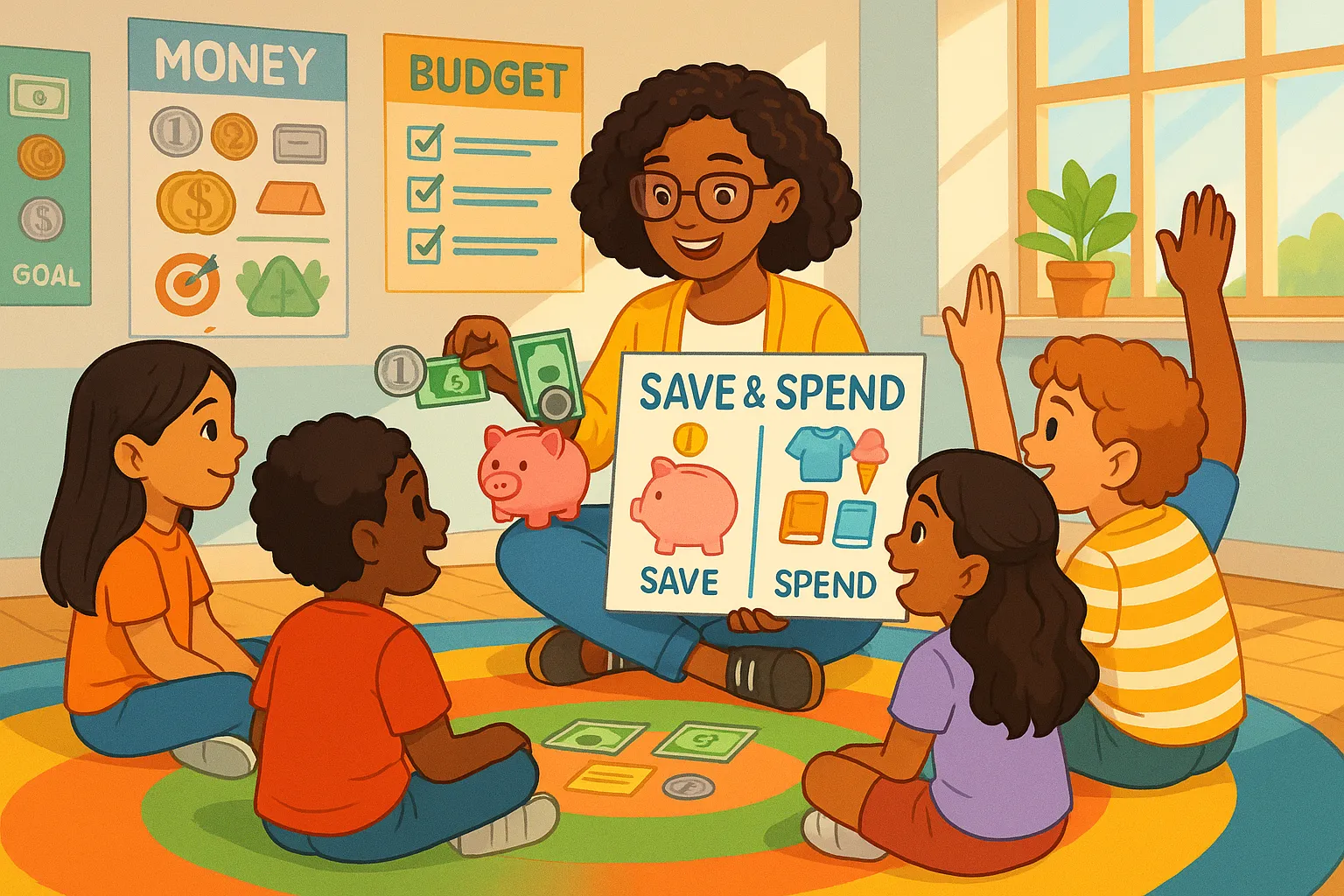
Although the family is fundamental, schools have an undeniable responsibility to prepare students for adult life, and this includes financial competence. Financial education in schools offers unique advantages that complement family learning.
First, formal education ensures that all students, regardless of family background, have access to basic financial knowledge. This is especially important for children whose parents may not have the necessary financial education to pass on.
Moreover, the school environment allows for a structured and progressive approach to financial education, where concepts can be introduced in a manner appropriate for each stage of cognitive development. Trained teachers can use proven pedagogical methodologies to make learning about finance engaging and effective.
Fortunately, there is a growing movement to include financial education in Brazilian school curricula. Since 2020, the National Common Curricular Base (BNCC) includes financial education as a cross-cutting theme, recognizing its importance. However, the
