
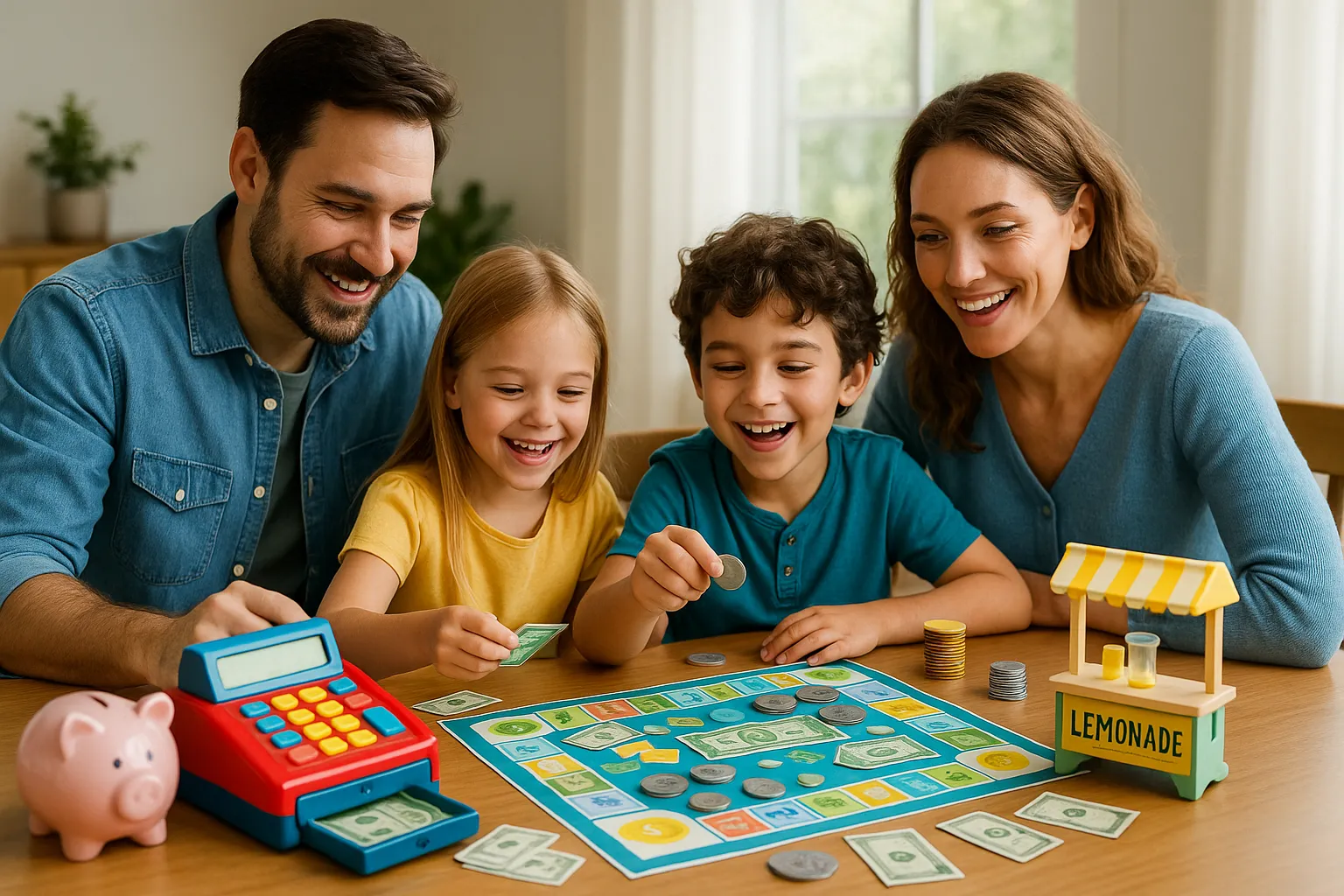
# 7 Fun Activities to Teach Your Child Money Management Early
Financial education is one of the most important skills we can pass on to our children, yet many parents struggle to approach this topic in an appropriate and interesting way. The good news is that teaching kids about money doesn’t have to be boring or complicated. On the contrary, when we turn financial learning into fun activities, children absorb fundamental concepts naturally and enjoyably.
Studies show that children who receive financial education early develop more responsible money behaviors in adulthood. According to research from the University of Cambridge, children’s financial habits form around the age of 7, emphasizing the importance of starting this educational process early.
In this article, you’ll discover seven practical and engaging activities that will help your child understand concepts like saving, spending wisely, planning, and even investing. These activities are suitable for different age groups and can be adapted as the child develops. Let’s turn financial learning into moments of fun and family connection!
1. Home Grocery Store: Learning About Buying and Selling
One of the most effective activities to teach basic concepts of financial transactions is setting up a home grocery store. This simple activity can be extremely educational and fun for children as young as 4 years old.
To start, set aside pantry items or toys your child already owns and create “prices” for each item using labels. You can use play money, create paper notes, or even use real coins under supervision. Establish a “budget” that the child can spend and let them choose the products they want to buy.
During the activity, teach important concepts like price comparison, change, shopping planning, and prioritizing needs versus wants. You can switch roles, allowing the child to be the seller in some rounds, which also helps develop basic math and negotiation skills.
This activity can evolve as the child grows. For older children, include concepts like discounts, promotions, and even the notion of profit for the seller. It’s an excellent way to teach financial education in a fun way, leveraging children’s natural interest in pretend play.
2. Goal-Oriented Piggy Bank: Visualizing Financial Objectives
Teaching children about the importance of saving becomes much more interesting when there is a concrete goal. The goal-oriented piggy bank activity turns saving into a visual and motivating activity.
Start by helping your child choose something they really want to buy – it could be a toy, a book, or a special experience. Then, create a personalized piggy bank together (it can be decorated by the child) and establish how much money is needed to reach that goal.
The key to this activity is visualizing progress. Attach a photo of the goal to the front of the piggy bank and create a simple chart where the child can color or mark the savings progress with each deposit. This makes the saving process tangible and rewarding.
To make the experience even more educational, teach about different sources of “income” for the child, such as allowances, rewards for extra tasks, or birthday gifts. Discuss the importance of being patient and consistent to achieve financial goals. This activity establishes solid foundations for financial planning that will be valuable throughout life.
3. Family Bank: Introducing the Concept of Interest
For slightly older children, from 8 or 9 years old, the “Family Bank” is an excellent tool to introduce more advanced concepts like savings with interest and loans.
Here’s how it works: parents act as the “bank,” and the child can deposit their money in this family institution. Each week or month, the bank pays interest on the deposited amount – it can be something symbolic like 5% per month. Use a simple spreadsheet or notebook where the child can track the growth of their money.
This system teaches the value of money working for you, a fundamental investment concept. The child sees how small amounts can grow over time through compound interest.
You can also introduce the concept of loans. If the child wants to buy something before having enough money, they can borrow from the family bank but must repay with interest. This teaches about the real cost of credit and the importance of planning purchases.
According to personal finance experts, understanding compound interest early on is one of the pillars for financial success in adulthood, making this activity particularly valuable.
4. Economic Treasure Hunt: Finding Savings Opportunities
This activity turns the family into financial detectives searching for opportunities to save money in daily life. It’s a perfect activity for children of all ages and can be adapted according to their level of understanding.
Create a “treasure hunt” around the house where children need to identify ways to save resources – and consequently money. This can include finding lights on in empty rooms, dripping faucets, electronics on standby, or food nearing expiration in the fridge.
For each “waste” found, the child earns points. Establish a reward system where points can be exchanged for small prizes or privileges. More important than the reward is the conversation about how each item found represents money being wasted.
Expand the activity to trips to the supermarket, where the child can look for products on sale, compare prices between brands, or identify items the family buys impulsively but doesn’t really need. This activity develops financial awareness and environmental responsibility simultaneously.
Over time, these “financial detectives” start applying these principles automatically, developing conscious consumption habits that will last a lifetime.
5. Financial Board Games: Learning Through Healthy Competition
Financial-themed board games are exceptional tools for teaching complex concepts in a playful and engaging way. Classic options like Monopoly remain relevant decades after their creation.
Monopoly teaches about buying properties, paying rent, strategic investment, and managing limited resources. During the game, talk to your children about the decisions they are making: why buy a particular property? Is it worth investing in improvements? How to manage money when it’s running low?
There are also modern versions and Brazilian games that may be more accessible, such as “The Game of Life,” which simulates financial decisions throughout a lifetime, including career choices, education, family, and retirement.
For younger children, simpler games involving counting money and making basic transactions are already valuable. The important thing is to make the moment fun and take the opportunity to discuss the financial principles involved.
A significant advantage of board games is that they allow children to experience financial consequences in a safe environment. They can “go bankrupt” in the game and learn from it without suffering real consequences. These experiences create emotional memory that influences future decisions.
6. Young Entrepreneur Project: Creating a Small Business
Nothing teaches about money more completely than earning your own money. Helping your child create a small business, even temporarily, offers valuable lessons about entrepreneurship, work, and financial management.
The classic “lemonade stand” still works, but there are countless other options: selling crafts, homemade cookies, gardening services for neighbors, organizing a used toy sale, or even creating digital content supervised by parents.
The educational process begins with planning. Help your child calculate costs (ingredients, materials), set prices that cover costs and generate profit, and think about marketing strategies. During the business operation, the child learns about customer service, responsibility, and persistence.
After sales, conduct a simple financial analysis: how much was invested? How much was sold? What was the profit? What can be improved? This practical experience offers a deep understanding of how money is earned and the value of work.
Important: keep expectations realistic and focused on learning, not profit. The goal is educational. Celebrate successes, but also use challenges as learning opportunities. This can be one of the most transformative experiences in a child’s financial education.
7. Party Budget: Financial Planning for Events
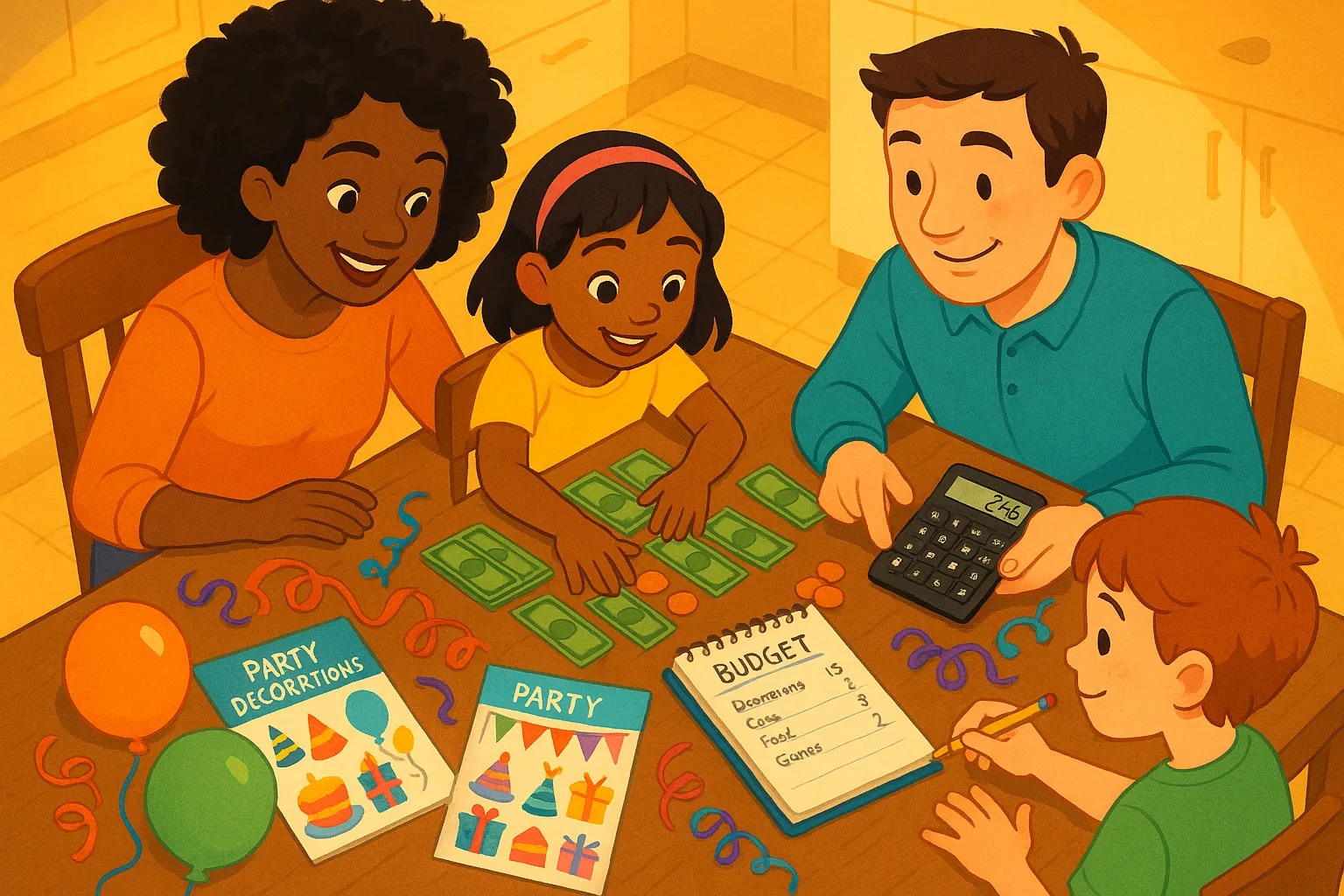
When your child’s birthday or any family celebration approaches, turn the planning into an educational activity involving budgeting and prioritizing expenses.
Set a total amount available for the party and sit down with your child to plan how this money will be distributed. Create categories like decoration, food, party favors, entertainment, and cake. Research prices together for each item and make decisions about where to invest more and where to save.
This activity teaches crucial financial planning concepts: working with limited resources, making choices based on priorities, researching before buying, and dealing with the impossibility of having everything you want within a budget.
