

7 Simple Budgeting Strategies to Transform Your Finances in 30 Days
If you feel like your money disappears before the end of the month, you’re not alone. Millions of people struggle daily to manage their personal finances, accumulating debt and living under constant stress. The good news is that transforming your financial situation doesn’t have to be complicated or time-consuming. With the right budgeting strategies, you can start seeing significant changes in just 30 days.
A well-structured budget is the foundation of any solid financial plan. It allows you to clearly see where your money is going, identify financial leaks, and make conscious decisions about your spending. More than just restricting expenses, a good budget provides financial freedom by ensuring you are in control of every dollar coming in and going out of your account.
In this article, we will explore seven practical and proven strategies that can revolutionize your relationship with money. These techniques are simple to implement, do not require advanced financial knowledge, and can be adapted to any income level. Get ready to take the first step toward the financial stability you’ve always wanted.
1. Track All Your Expenses for 7 Days
Before creating any budget, you need to know exactly where your money is going. Most people drastically underestimate their actual spending, especially those small daily expenses that seem insignificant but add up to a considerable amount at the end of the month.
For the first seven days, record absolutely everything you spend. This includes breakfast, parking, grocery shopping, app subscriptions, snacks, transportation, and any other expense, no matter how small. Use a financial control app, a simple spreadsheet, or even a notebook—the important thing is to record everything immediately after each expense.
This exercise reveals consumption patterns that often go unnoticed. You might discover, for example, that you spend much more on delivery than you imagined or that those “small online purchases” add up to hundreds of dollars monthly. According to data from the Central Bank of Brazil, lack of control over small expenses is one of the main factors of indebtedness among Brazilian families.
At the end of these seven days, categorize all expenses (food, transportation, leisure, housing, etc.) and sum the values of each category. This will be the starting point to build your realistic budget and identify areas where you can save without sacrificing your quality of life.
2. Apply the 50-30-20 Rule
One of the most popular and effective budgeting strategies is the 50-30-20 rule, developed by American Senator Elizabeth Warren. This methodology divides your monthly net income into three main categories, offering a simple yet powerful framework to organize your finances.
The 50% is allocated to essential needs—those expenses you cannot avoid, such as housing (rent or mortgage), water, electricity, gas bills, basic food, transportation to work, health insurance, and other fundamental expenses. If your basic needs exceed 50% of your income, it’s a warning sign indicating the need to reduce costs or increase income.
The 30% is for wants and lifestyle—includes leisure, dining out, streaming, gym, clothes, hobbies, and other non-essential expenses that improve your quality of life. This category offers flexibility and prevents the budget from being so restrictive that it becomes unsustainable.
The final 20% should be directed towards savings and debt repayment. This is the portion that builds your financial future, including an emergency fund, investments, retirement, and debt payoff. For those starting from scratch, these 20% may seem impossible, but starting with any percentage is already significant progress.
To implement this rule, calculate your monthly net income and multiply by the corresponding percentages. Use these values as a guide to distribute your spending. Over time and adjustments, you will be able to align your actual expenses with these percentages, creating a balanced and sustainable budget. Just like learning to manage your money is essential for long-term financial success.
3. Create a Minimum Emergency Fund
One of the biggest financial mistakes people make is not having a reserve for unforeseen events. When an emergency arises—a car breakdown, unexpected medical expense, job loss—those without reserves end up resorting to overdrafts or credit cards, starting a vicious cycle of high-interest debt.
In the first 30 days of your new budget, make it an absolute priority to create an initial emergency fund of at least $200 to $400. This amount is not enough for all scenarios, but it provides a basic cushion that can prevent small emergencies from turning into major financial crises.
To quickly accumulate this amount, you can take some temporary measures: sell items you no longer use, do some extra work (freelance, sales, services), temporarily redirect money you would spend on leisure, or cut unnecessary expenses for a few weeks. The goal is to create this fund as quickly as possible, as it acts as insurance against unforeseen events.
Keep this money in a separate account, preferably in a savings account or immediate liquidity investment, but not in the same account you use for daily spending. Physical separation makes impulsive use of this resource more difficult. According to financial experts, the ideal is to eventually increase this fund to cover 3 to 6 months of essential expenses, but starting with a smaller amount already offers significant protection.
4. Eliminate One Financial Leak Per Week
Financial leaks are those recurring expenses we continue paying out of inertia, but that add no real value to our lives. They silently drain our budget month after month, without us realizing the accumulated impact.
During the four weeks of your 30-day challenge, identify and eliminate one financial leak per week. In the first week, review all your subscriptions and memberships: streaming services you rarely use, gyms you don’t attend, digital magazines you don’t read, premium apps you forgot you had. Cancel at least one.
In the second week, focus on expensive habits that can be replaced with more economical alternatives. For example, if you buy coffee out every day, calculate how much this represents per month and consider making coffee at home and carrying it in a thermos. A $3 coffee per day represents $90 per month—$1,080 per year.
In the third week, analyze your impulse purchases. Set a 48-hour waiting period before making any unplanned purchase over $20. You’ll find that most consumption desires disappear after this reflection period, saving you hundreds of dollars.
In the fourth week, renegotiate a service you pay for regularly. Call your phone, internet, or cable TV provider and inquire about cheaper plans or promotions. Companies often offer discounts to customers who threaten to cancel. A simple call can save you $10 to $40 per month.
Eliminating four financial leaks in a month can easily free up an additional $60 to $100 in your budget, money that can be redirected to your emergency fund or debt repayment.
5. Use the Digital Envelope Method
The envelope method is a classic budgeting technique that has been used for generations. Traditionally, you withdraw your salary in cash and distribute it into physical envelopes labeled with different expense categories (food, transportation, leisure, etc.). When the money in an envelope runs out, you can’t spend in that category until the next month.
In the digital age, you can adapt this method using multiple bank accounts or financial organization tools. Many digital banks allow you to create “boxes” or subaccounts within your main account, functioning exactly like virtual envelopes.
As soon as you receive your salary, immediately distribute the money among these categories according to your planned budget. For example, transfer the amount allocated for groceries to a specific box, leisure money to another, and so on. When making purchases, use only the card or account linked to that specific category.
The great advantage of this method is the visual and tactile awareness of your spending limits. You clearly see how much is left in each category and are forced to make conscious choices when resources run low. This eliminates the nebulous feeling of not knowing whether you can or cannot make a particular purchase.
To implement in the first 30 days, start with three to five main categories. Don’t complicate things too much initially—you can refine the system later. The goal is to create the habit of spending consciously within predefined limits, something that can completely transform your relationship with money.
6. Automate Your Savings and Payments
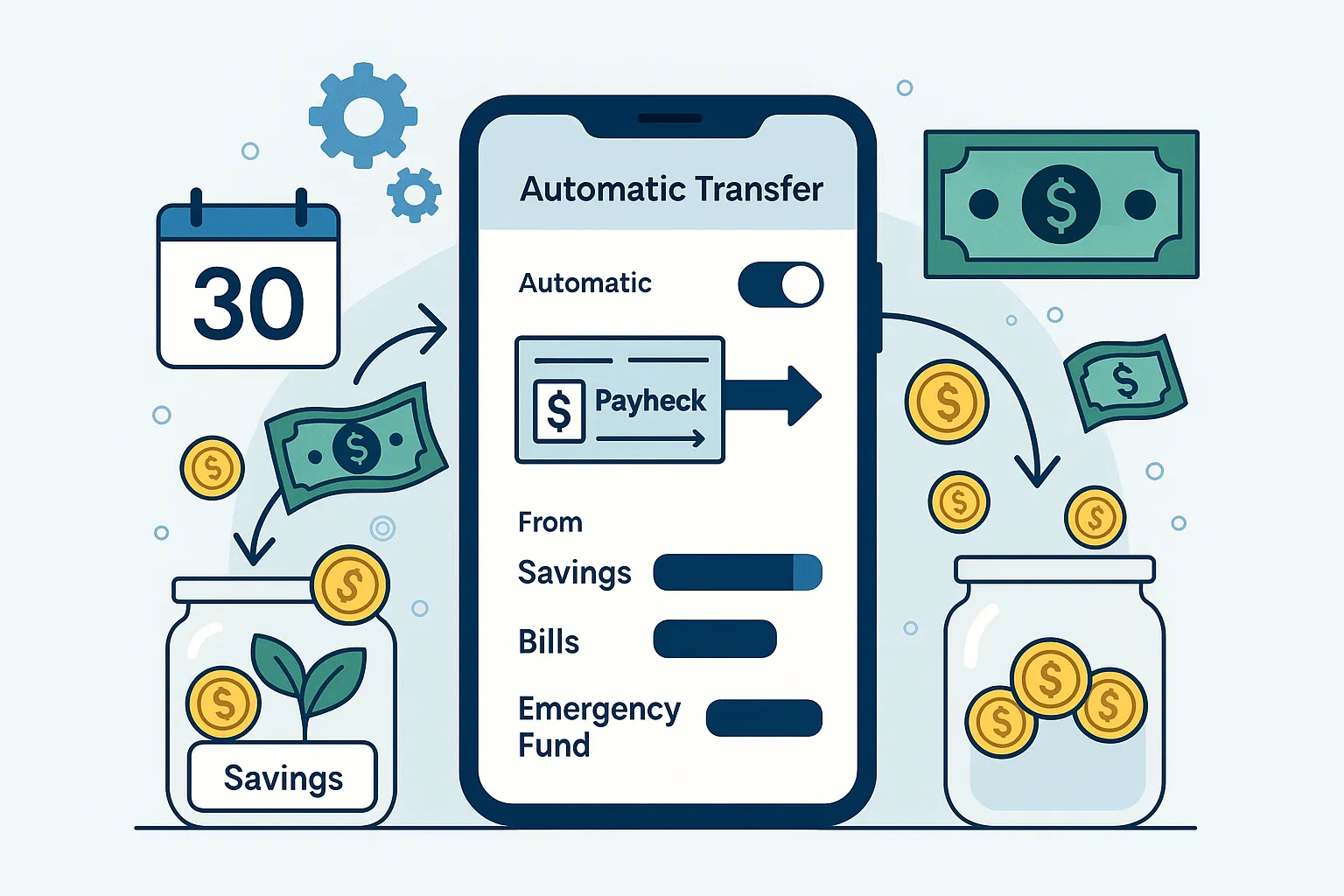
One of the most important findings of behavioral economics is that people are much better at saving when the process is automatic, removing the need to make conscious decisions repeatedly. When we leave savings to the
