
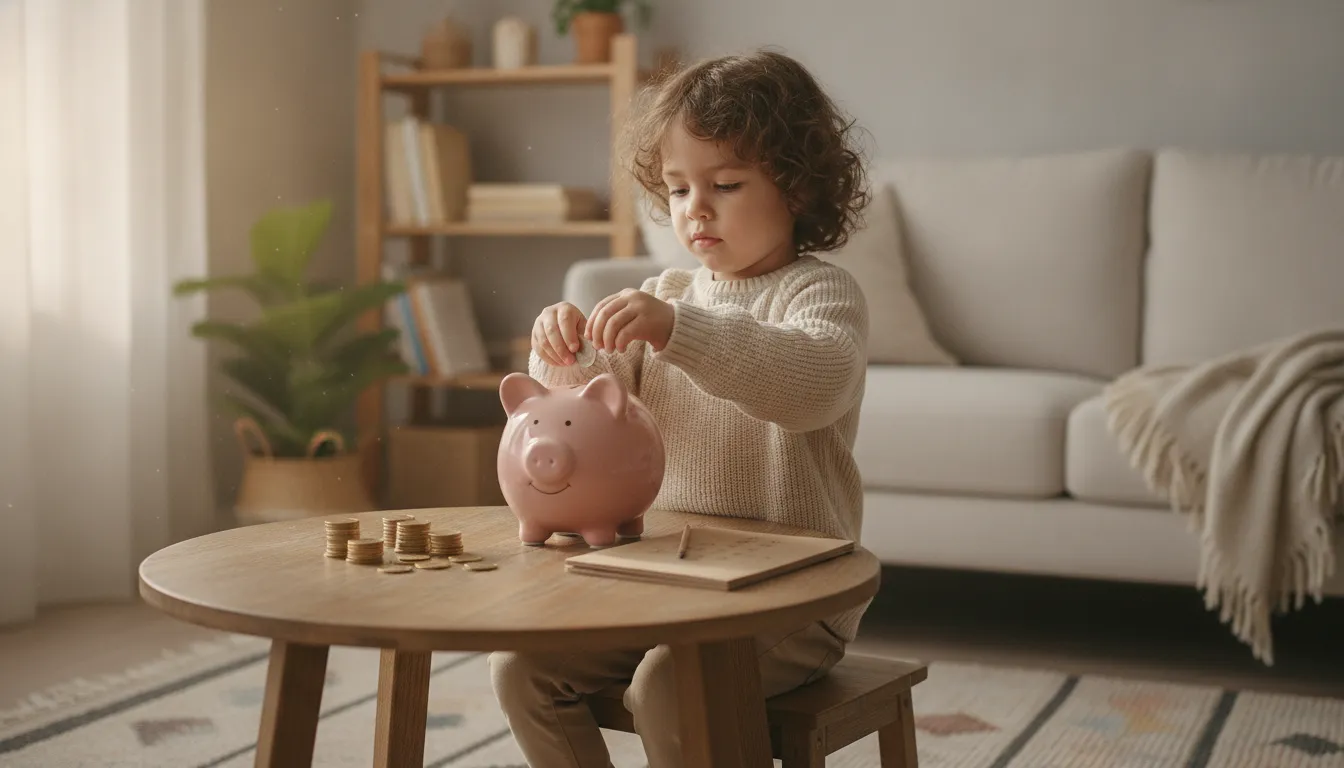
Imagine a 10-year-old child who, upon receiving birthday money, doesn’t rush to spend it all at once. Instead, they set aside a portion to save, another for a goal they planned weeks before, and even allocate some to help someone. Does it sound utopian? It’s not — and the difference between this child and others of the same age often lies in how the family approached the topic of money at home.
Financial education for children and teenagers is still considered taboo in many Brazilian families. Money is an adult’s matter, they say. However, research in psychology and behavioral economics shows that financial habits begin to form in childhood and that basic concepts of saving and planning can be understood around the ages of 6 to 7. Delaying this conversation doesn’t protect children — it may actually leave them more vulnerable to financial pitfalls in adulthood.
This article provides a practical guide for parents and guardians who want to start this journey with children and young people in a playful, honest, and progressive way. There’s no magic formula or miraculous financial product in this story — there’s a mindset building, and it begins long before the first bank account.
Why Teach Financial Education Early?
The Brazilian educational system still doesn’t consistently and obligatorily include financial education in curricula — despite the National Common Curricular Base (BNCC) mentioning the topic within the competence of financial mathematics. In practice, most children reach adolescence without knowing what interest, budget, or savings are in an applied way.
The result is reflected in the data: the indebtedness of Brazilian families is historically high. According to the National Confederation of Commerce (CNC), the percentage of indebted families in Brazil has remained high in recent years. It’s not just about bad luck or economic crisis — much of this indebtedness has roots in behaviors learned (or not learned) in childhood.
Teaching finances early doesn’t mean turning the child into a small variable income investor. It means helping them understand that money has a source, a destination, and a limit — and that financial choices have consequences.
When and How to Start: By Age Group
The approach needs to respect the cognitive development of each phase. A concept that makes sense to a 15-year-old may be too abstract for a 5-year-old. Here is a possible path:
Ages 4 to 7: Concrete is the Beginning
At this stage, money needs to be physical. Real coins and bills have much more impact than a number on a screen. Pretend play with a “store” at home, for example, teaches the notion of exchange — you give something (money) to receive something else (product).
- Introduce coins of different values and teach how to identify them.
- Use three jars or envelopes with labels: spend, save, and give (or help someone).
- Explain that when the money is gone, it doesn’t just reappear — at least not immediately.
Ages 8 to 12: Allowance and Goals
An allowance — when well-structured — is one of the most powerful tools for financial education. It realistically simulates the budget the child will have as an adult: a periodic income, decisions on how to use it, and real consequences if they spend it all too soon.
Note: An allowance is not a reward for behavior nor a punishment. It’s a learning tool. Mixing allowance with rewards for grades or punishment for bad behavior distorts the child’s relationship with money.
- Set a value consistent with the family’s reality.
- Establish together which expenses are the child’s responsibility (a special snack, a magazine, a small game).
- Encourage the child to set a savings goal — something they really want and that takes a few weeks or months to save for.
- Don’t bail them out when the money runs out before the deadline. The experience of “running out” is part of the learning.
Ages 13 to 17: Introduction to the Real Financial System
At this stage, the conversation can advance to more concrete concepts:
- What interest is (both what the bank charges and what accrues on an investment).
- How a bank account and a debit card work.
- What inflation is and why keeping money “under the mattress” causes it to lose purchasing power over time.
- The difference between wanting and needing.
Teenagers can also begin to understand, in an introductory way, what investing is — without the pressure of “making money grow a lot,” but with the understanding that there are ways to make money work while waiting.
Accessible Tools and Resources for Learning
Savings and Youth Account
Many Brazilian banks offer accounts for minors with parental authorization. The savings account, although not necessarily the option with the best return (the yield varies according to the Selic rate — check the Central Bank at bcb.gov.br for the current rate), has a real pedagogical advantage: it’s simple, visual, and exempt from Income Tax for individuals in general.
For learning purposes, what matters is not the yield itself, but the child seeing the balance grow and understanding that money saved can earn more money over time — this is the concept of compound interest in its most accessible form.
Educational Games and Apps
There are board games focused on financial education adapted for children (children’s versions of classic resource management games, for example). Some apps also simulate budgets in a gamified way. The important thing is that the learning is contextualized — the game should generate conversation, not replace it.
Children’s Books About Money
The Brazilian publishing market has grown in this area. Educational books that address savings, choices, and financial goals narratively are powerful allies, especially for children between 6 and 10 years old.
The Family Conversation: The Role of Adults
No tool replaces the example. Children observe behaviors before absorbing concepts. If the adults around them talk about money with anxiety, secrecy, or impulsiveness, the child will internalize these patterns.
This doesn’t mean the family needs to be financially perfect to educate well. On the contrary: talking honestly about mistakes, difficulties, and lessons learned is one of the richest forms of financial education possible. “This month we went beyond what we could spend, and now we need to adjust” is a real and powerful lesson.
Some simple practices to incorporate into daily life:
- Include children (in age-appropriate language) in major family purchasing decisions.
- Explain the difference between price and value — why something more expensive may be worth more, and when it isn’t.
- Show how a water, electricity, or internet bill works: where it comes from, how much it costs, how it can be saved.
If you are looking to better organize your finances to set an example, the article How to Invest 100 Reais a Month Consistently can be a good starting point.
Important Precautions: What to Avoid
Financial education for children has pitfalls. Some of the most common:
- Promising guaranteed returns: never tell a child that “the money will double in such a time.” Every investment involves risk, and this needs to be part of the conversation from an early age.
- Turning money into a source of anxiety: the goal is competence, not fear. Children who grow up with financial terror may develop dysfunctional relationships with money in adulthood.
- Using money as emotional control: rewarding with money for affection or punishing by withdrawing material resources mixes dimensions that should be separate.
- Ignoring the socioeconomic context: not all families can afford to give an allowance or open a bank account for their children. Financial education can happen even in contexts of restriction — and it may be even more urgent in these cases, precisely to break cycles.
When Young People Start Working: The First Salary
For young people aged 14 to 17 who work as young apprentices (provided for in the Consolidation of Labor Laws), or those over 18 who are in their first job, the first salary is a crucial pedagogical moment.
Before any spending or investment decision, guide the young person to understand the paycheck: what gross salary is, what deductions are (INSS, for example), and what remains net. This basic reading is rarely taught and avoids frustrating surprises.
Next, the concept of paying yourself first — setting aside a portion of the salary for savings before spending anything — is one of the most valuable habits that can be created at this stage.
Conclusion: The Best Investment is Education

Teaching a child to manage money isn’t about creating little speculators or portfolio optimizers. It’s about offering them a life skill that most Brazilian adults never received in a structured way.
The path is gradual, contextualized, and, above all, built in everyday conversation. It’s not necessary to wait for the family’s financial situation to be perfect to start — in fact, it’s precisely in the imperfections that the most valuable lessons lie.
If you want to deepen your own financial knowledge while building this learning environment for your children, also check out the Guide to Getting Out of Debt with Little Money — because taking care of your own finances is always the first step to teaching by example.
Educational Note: This article is for educational and informational purposes only. No part of this content constitutes investment advice, financial product, or personalized strategy. Each financial situation is unique. For investment decisions and financial planning, consult a qualified professional registered with the Securities and Exchange Commission (CVM) at cvm.gov.br.
- Turning money into a source of anxiety: the goal is competence, not fear. Children who grow up with financial terror may develop dysfunctional relationships with money in adulthood.
- Promising guaranteed returns: never tell a child that “the money will double in such a time.” Every investment involves risk, and this needs to be part of the conversation from an early age.
- Don’t bail them out when the money runs out before the deadline. The experience of “running out” is part of the learning.
- Explain that when the money is gone, it doesn’t just reappear — at least not immediately.
