

# Master Your Money: How In-Person Financial Education Can Transform Your Life in 30 Days
Financial education is one of the most crucial skills anyone can develop in modern life. Despite living in a digital age full of online information, many people still struggle to organize their personal finances and achieve economic stability. This is where in-person financial education emerges as a powerful and transformative tool, capable of creating significant changes in just 30 days.
Unlike online courses or individual reading of financial materials, in-person programs offer an immersive experience with direct interaction with experts and other participants who share similar challenges. This intensive approach allows not only theoretical learning but also the practical application of concepts that can completely revolutionize your relationship with money.
In this article, we will explore in detail how in-person financial education can transform your financial life in a month, the main benefits of this learning format, and how you can make the most of this experience to build a more solid and prosperous financial future.
Why 30 Days Are Enough to Start a Financial Transformation
Behavioral science shows us that it takes approximately 21 to 30 days to form a new habit. When we apply this principle to personal finances, we realize that an intensive month of in-person financial education may be exactly what you need to establish solid foundations for a healthy financial life.
During this period, you not only absorb theoretical information but also start implementing immediate practical changes. The structure of a 30-day in-person program generally includes regular sessions that keep you committed and accountable for your financial actions, unlike self-administered courses that can be easily abandoned.
Moreover, the intensity of a concentrated program creates a sense of urgency and focus that is difficult to achieve when you try to learn finances in a fragmented way. You dive completely into the subject, eliminating distractions and truly prioritizing your financial education. Many participants report that this immersion is the differentiator that finally helped them get out of debt and regain their financial freedom.
The Unique Advantages of In-Person Financial Education
While there are numerous online resources about personal finance, in-person education offers distinct benefits that are hard to replicate in a virtual environment. Face-to-face interaction with qualified instructors allows for a level of personalization and clarity that transcends what is possible through videos or texts.
First, there is the aspect of accountability. When you commit to an in-person course, you are making an investment of time and, usually, money. This tangible commitment significantly increases the chances of you fully dedicating yourself to the process. You have fixed schedules, specific locations, and a structure that naturally creates discipline.
Second, the opportunity to ask questions in real-time and receive personalized answers for your specific situation is invaluable. Each person has a unique financial reality, and the ability to discuss your particular challenges with an expert can dramatically accelerate your progress. This is especially useful when implementing smart strategies to get out of debt that need to be adapted to your reality.
Third, networking with other participants creates a fundamental support network. You meet people facing similar challenges, can share experiences, and create study or accountability groups that continue after the course ends. Studies show that social support is one of the most important factors in maintaining new healthy financial behaviors.
What You Will Learn in a 30-Day In-Person Program
A well-structured in-person financial education program addresses various fundamental aspects of personal finance. During the first module, usually focused on the first week, you will learn to make a complete diagnosis of your current financial situation. This includes mapping all your income sources, listing all expenses, identifying debts, and calculating your net worth.
This initial financial snapshot, although it may be uncomfortable for some, is absolutely essential. You cannot improve what you do not measure. Many people avoid honestly looking at their finances out of fear or shame, but the structured and supportive environment of an in-person course makes this process more manageable.
In the second week, the focus usually shifts to creating a realistic and functional budget. You will learn different budgeting methodologies, such as zero-based budgeting, the 50/30/20 method, or the envelope system. The instructor will help you choose the method best suited for your lifestyle and personality. Implementing these techniques can literally transform your finances in 30 days.
The third week generally covers debt reduction strategies and savings increase. You will learn about the snowball versus avalanche method for debt repayment, how to negotiate lower interest rates, and strategies to start building an emergency fund even with limited resources.
Finally, the fourth week is dedicated to long-term planning, including basic investments, retirement planning, and asset protection. While 30 days are not enough to completely master these advanced topics, you will receive a solid foundation and a roadmap to continue your financial education after the course ends.
Practical Tools and Resources Provided
The best in-person financial education programs not only provide theoretical knowledge but also equip participants with practical tools that can be implemented immediately. This may include personalized budgeting spreadsheets, recommended apps for expense tracking, templates for debt negotiation, and action checklists.
Many programs also provide access to specialized financial calculators that help you visualize the impact of different financial decisions. For example, you can see how long it will take to get out of debt using different repayment strategies or how much you need to save monthly to achieve specific long-term goals.
Additionally, participants usually receive reference materials that they can consult after the course ends, creating a permanent resource for their ongoing financial journey. According to studies by the Central Bank of Brazil on financial citizenship, having tangible resources significantly increases the implementation rate of healthy financial behaviors.
Overcoming Psychological Barriers Related to Money
One of the most valuable aspects of in-person financial education is working with psychological and emotional barriers related to money. Many of our financial behaviors are shaped by deeply ingrained beliefs about money that we developed in childhood or through past experiences.
In a face-to-face environment, experienced instructors can identify these limiting thought patterns and help you reframe them. For example, you may have the belief that “I will never be good with money” or “people like me can’t save.” These internal narratives sabotage your financial efforts, and working to change them is as important as learning budgeting techniques.
The in-person format also allows for experiential exercises and group dynamics that help identify and transform your emotional relationship with money. You can participate in simulations, role-playing for financial negotiations, and deep discussions about personal values and how they relate to your financial decisions.
According to research by the American Psychological Association, financial stress is one of the main sources of anxiety for adults, and addressing the emotional aspects of finances is as crucial as mastering technical skills.
Immediate Implementation and Follow-Up
One of the distinctive features of effective in-person programs is the emphasis on immediate implementation. Unlike courses that are purely informative, the best programs include financial “homework” that you must complete between sessions. This may include tasks like opening a separate savings account, canceling unnecessary subscriptions, or making calls to negotiate debts.
In subsequent in-person sessions, you report your progress, share challenges encountered, and receive feedback and adjustments to your strategies. This regular accountability is extremely powerful for maintaining momentum and ensuring that knowledge turns into action.
Many programs also include some form of follow-up after the initial 30 days. This may be through monthly check-in sessions, access to an online alumni community, or additional resources. This ongoing support is crucial because financial transformation does not end after 30 days – it is a continuous process that requires adjustments and refinements over time.
Success Stories and Expected Results
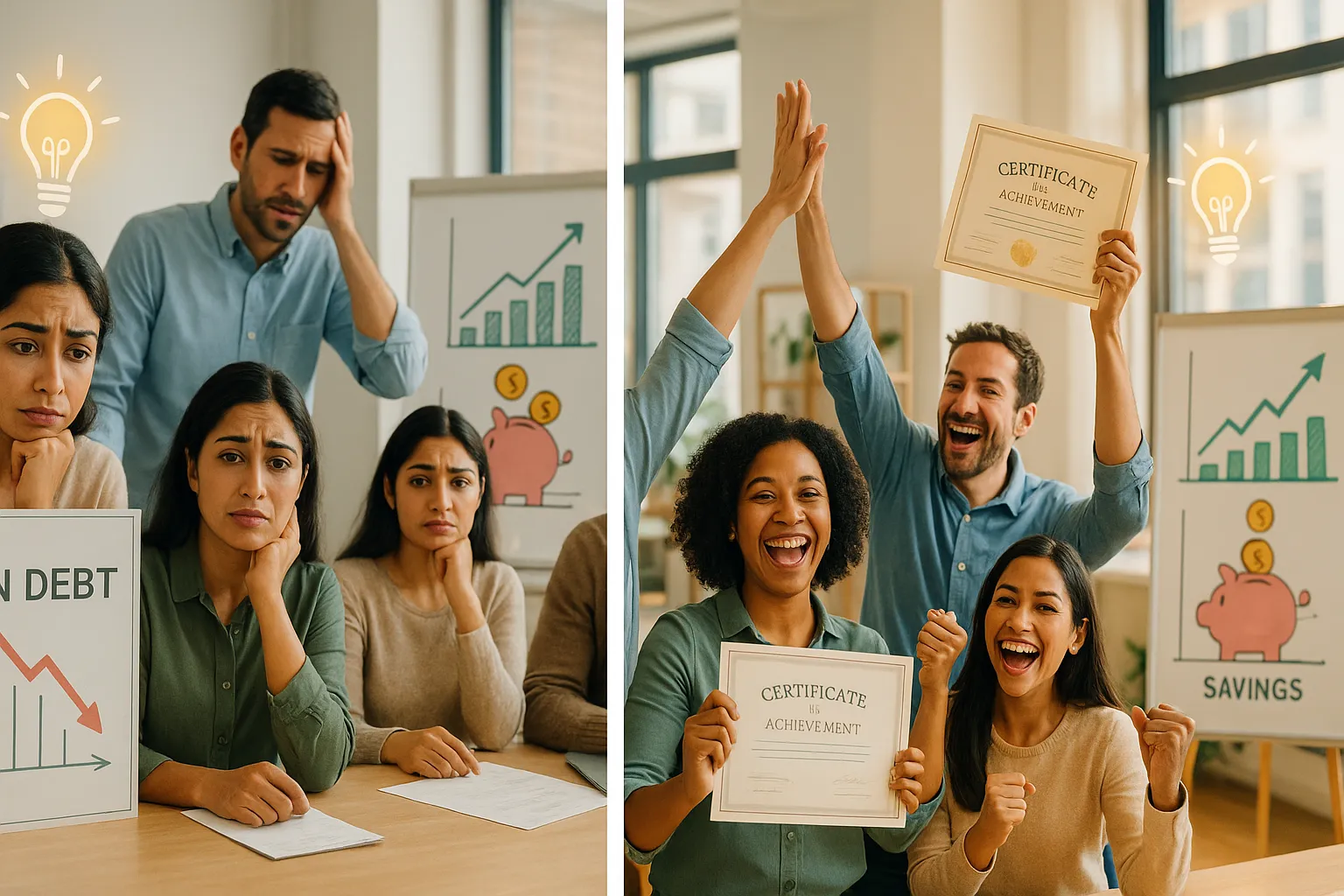
The transformation stories of people who participated in intensive in-person financial education programs are inspiring and demonstrate the power of this approach. Many participants report having eliminated thousands of dollars in debt in the first few months after the course, simply by applying the strategies learned.
Others share that they finally managed to build their emergency fund for the first time in adult life or significantly improved their credit scores. Some discover opportunities to increase their income that they had never considered or learn to better negotiate salaries and benefits.
Besides tangible financial results, many participants report significant emotional and psychological benefits. The reduction of money-related stress, improvement in sleep quality, and strengthening of relationships that were tense
